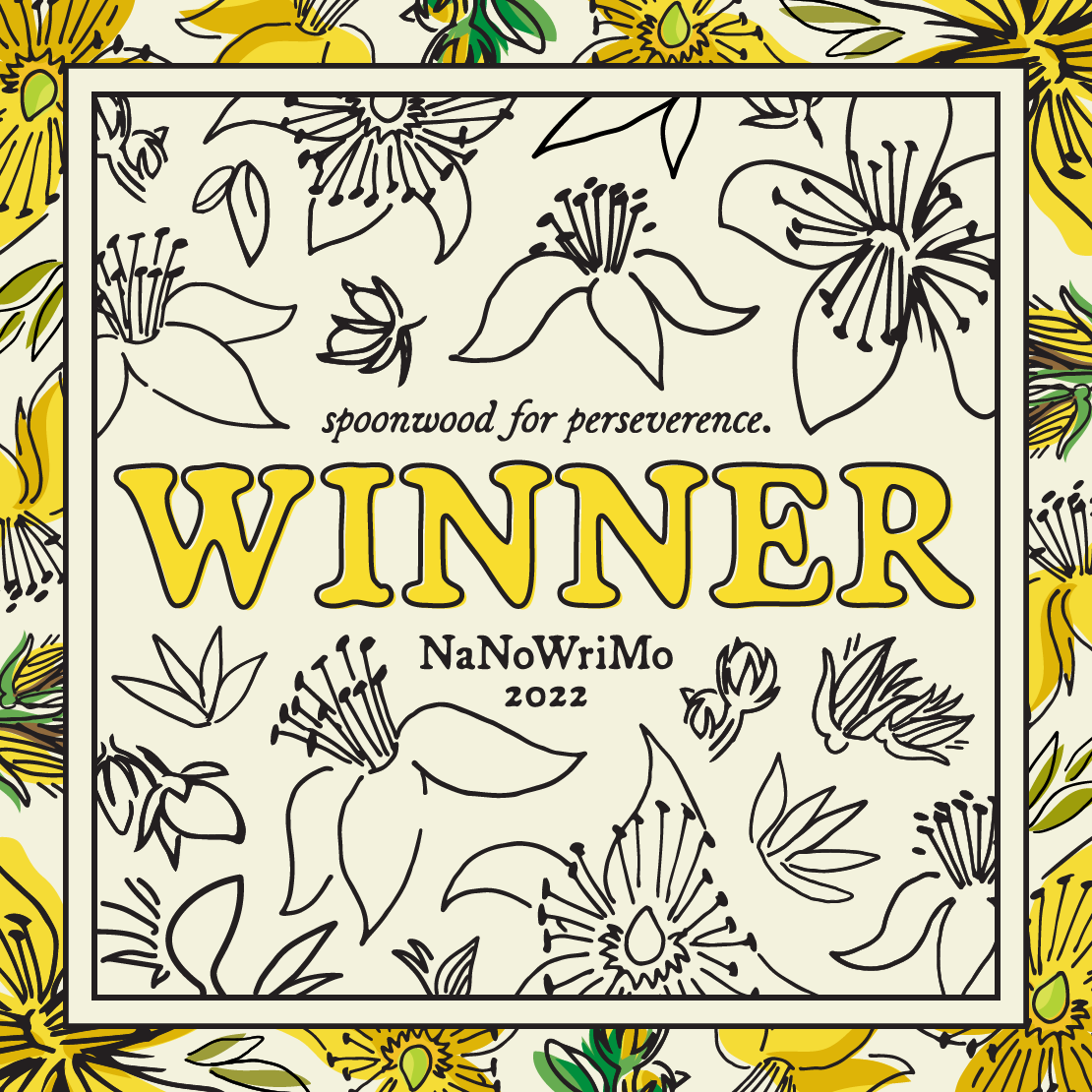
2022 NaNo Winner!

Number 19 officially went into the books on November 23rd and that’s when the story was finished, too. I pushed a little to get it finished before Thanksgiving, but for the most part, kept a constant 2,000 words a day word count. I tended to make the most productive progress doing 500 word sprints in between playing rounds of a puzzle game. It just seemed easier to write that way when I was giving my brain little breaks rather than trying to push straight through. It’s not the first time I’ve used this distraction/sprinting technique. I do whatever I need to do in order to make the words happen.

Thanks to me being less than smart with my scheduling, I ended up writing most often after work. Or at work, in some cases. I’m a dedicated employee. Anyway. That was different from previous years as my goal was always to get as much, if not all, of my writing before my shift. But since I had a few other projects going on, I had to rearrange my priorities. I will readily admit that this was one of the more stressful Novembers I’ve had in a while. I got through it, but I’m in no hurry to do something like that again.

The final first draft of Leave Well Enough Alone is something of a mess, naturally. Maybe it wouldn’t be if I’d done a slightly more solid outline. And by slightly more, I mean anything better than the vague game plan I went in with. But that’s not how I live my life.

I realized about two-thirds of the way into the first draft that I borked my timeline. Not long afterwards, I realized that I probably should have written the story differently. As I mentioned, I wrote alternating timelines. I think I might have been better off writing the 1976 timeline first in its entirety and then tailored the present day timeline to better fit it. Also, neither timeline turned out the way I thought it would, but that tends to happen when I don’t have a more robust and solid outline.

It was also about the time I realized I borked my timeline that I realized that Trix and Miggy should have had different jobs and objectives, but whatever. That’s what revisions and rewrites are for.

And when I get around to them, there will be a lot. Most likely starting with writing the 1976 timeline out in full so I know better how to make the present day timeline work.

But that’s future me’s problem.

Right now, present me is savoring yet another NaNo victory.

The Muses

I wrote ages ago about muses and how I didn’t have one. However, I recently realized that I do have a muse. I have several of them, in fact. It’s just they’re not what I thought they’d be.

A muse, according to the dictionary, is “a person or personified force who is the source of inspiration for a creative artist”. I have always interpreted this to be more of the figurative meaning, an imaginary being that sprinkles creative dust on my head, which infiltrates my brain and gives me ideas. And in that respect, I never had a muse. I was never blessed in such a fashion.

As it turns out, though, I have been blessed with multiple muses over the years. I just didn’t realize it at the time. I was looking for fairies when what I got was people, places, and things.

My muses are concrete nouns.

For example, there’s a tree across the street in my neighbor’s yard. I don’t know what kind it is. It’s just big and it’s been there for years and it’s very pretty in the fall, but the wind strips its leaves pretty quickly. It’s usually bare by Halloween.

That tree has been in several of my stories and at least two of those stories came from ideas I got from that tree, from wanting to write about it. It was a muse.

There are places that I’ve used the same way. The library I work at has popped up in my stories long before I started working there. I wouldn’t be writing Defending The L right now if the library hadn’t inspired the story. The local lake, the house across the street, the zombie car wash, all inspired stories. They were muses.

And, yes, there are people who’ve served as muses. People who I think would make excellent characters so I build stories around them. People I want to give starring roles. People who I will absolutely not name here nor will I name of any of the stories they inspired. But they were all muses.

The thing about these muses, the real thing that I think tripped me up in seeing them for what they were, is that I thought of muses as more of something permanent. The fairy that was always there, flitting about with their creativity dust. As it turns out, muses are more impermanent than I previously thought. I don’t think that they’re always supposed to stick around. They serve their creative purpose and then they return to being the nouns they’ve always been.

Of course, muses, like inspiration and creativity and all of those other intangibles, are highly individual. I’m sure some people have muses that stick around forever. Maybe one day I’ll be lucky enough to have that happen.

And I’m sure there are some people who are lucky enough to have the fairy kind of muse, sprinkling creativity all over them. I know that I’ll never be lucky enough to have that.

I’ll have to settle for the nouns that happen to catch my attention.

Page-A-Day and Sunday

As I mentioned, I’m currently writing a page-a-day novel as well as something I’ve come to think of as my Sunday novel. I’ve been doing them both for a few months now, long enough that I’m ready to talk a little bit about each project, but more importantly talk about how different the processes have been for me, particularly in light of working on a NaNo novel at the same time.

NaNo, of course, is NaNo. I’ve finished it in 12 days, I’ve finished it in 30 days, I’ve totally failed it. My goal is to write 50,000-60,000 words in a month, about 2,000 words a day. After years of this, I’ve found a happy medium between outlining and pantsing, giving myself a basic blueprint of the story with room to wild out and surprise myself. It’s been a winning formula for quite some time (when I’m not cheating, obviously). The resulting first drafts vary from needing a lot of rewrites to just needing a few rounds of revisions.

Blasting out that first draft as fast as possible has been my way of writing for a majority of my writing career and it’s how I’ve done most of my projects.

Defending The L is not my first page-a-day project. A few years ago, I decided to shake up my creativity by writing one page a day every day for a year because as the adage goes, if you write a page a day, by the end of the year, you have a 365 page novel. At the time, I was looking for some kind of creative productivity boost. I had a general idea of the story, a few scenes I knew I was writing towards, and I just sort of let it unfold, day by day, page by page.

My current page-a-day is a little different. I started writing Defending The L this way because I wanted to write this story, but didn’t have time to devote to it to do it NaNo-style, nor did I want to wait until NaNo. I also don’t have the goal of writing a page a day for a year, just until the story is done. As of this post, it’s right around NaNo length of about 50,000 words and into the third act of the story, which takes a bit of a horror turn.

Defending The L also has the dual purpose of being a bit of a catharsis piece. It’s set in a library, so I’ve been able to vent some of my frustrations with the job through the story.

Like the previous page-a-day (which still doesn’t have a title and I haven’t looked at since I wrote it) and much of my NaNo work, this one is going to need some revising, but more than likely not any heavy re-writing. Of course, I’m not finished yet, so fingers crossed.

My Sunday story, That’s Punk, is an entirely different beast and honestly, it’s a little scary.

First of all, there’s nothing horror or fantasy or otherwise genre about it. It’s straight contemporary fiction, which for me is way out of my comfort zone.

Second of all, instead of writing this first draft as fast as I possibly can and getting it all out in one hunk I can shape through rewrites and/or revising, I’ve only been able to work on this story on Sundays. And when I do work on it, I go back and re-read what I wrote the previous week, revising anything I’ve decided needed changing while it’s simmered in my brain since the last time I looked at it, and then I add new material. There’s also no goal before I call my day on That’s Punk done. No word or page counts. Once I do my rewind and revise, I decide how much I want to get done that day. Usually, it’s a scene, or maybe not even that. I stop where it feels good. I’ve been working on this story since the end of August and I’ve only got about thirty pages written.

It’s so weird on so many levels for me. I’m writing something I don’t normally write in a way I don’t normally write. And you know what? I think I like it. There’s something indulgent about being able to take my time with a story, revise it as I go, and keep my goals fluid. There’s something luxurious about having this dedicated time to work on something on a day with no other expectations. I’m not rushing to get anything done because I have to go to work or I have errands to run or dinner to make. I don’t do anything on Sundays by design. Writing this story on my lazy day has turned into a form of relaxation for me, as strange as that sounds.

November has been an interesting writing month for me for years thanks to NaNo and the challenge of writing a 50,000 word novel around daily life. But this November, writing three different novels, three different ways…it’s been eye-opening.

One thing about being a writer…I never get bored exploring and developing my craft.

“What Are You Working On?”

This is a trick question.

“What paranoia are you on about now?”

Hear me out. This is a trick question in two ways.

Number one, the person asking the question is more than likely just being polite. They don’t really care about what you’re working on. They’re just trying to pretend to have interest in your little writing hobby because they want to be supportive, but they’re really not that invested. You can tell by the way their eyes glass over and they nod along, not really listening, just waiting for you to finish so they can say, “Wow. That sounds great. I can’t wait to read it.” And we all know they’ll never read it. Because they’ve never read anything you’ve written because *insert reason here*.

The only correct answer to this question is to say what kind of project you’re working on.

“Oh, I’m in the middle of revising a short story for a contest.”

“Oh, that’s great. I can’t wait to read it. I hope you win!”

“Thanks.”

And scene. Small talk achieved. Everyone leaves with their egos intact. To go into any further detail about whatever you’re working on is to risk that glazed look and feeling your enthusiasm for your project/writing career deflate. And we don’t want that.

If they attempt to engage further by asking for story specifics, don’t panic in the face of this unanticipated interest. Simply demure, saying you try not to talk too much about your projects when you’re working on them.

Which brings me to the second tricky point.

If you do find someone who is genuinely interested in what you’re working on, then talking about the project, no matter how enthusiastic you are about it, can drain some of that energy you have for it. I don’t know why this is. But it seems like talking about the story you’re working on, particularly in the first draft stage, makes it less engaging to work on. It’s like the magic is escaping the bottle and it’s escaping because your dumbass keeps taking the lid off of it so other people can see it.

It’s true that sometimes talking about your work can help you see and/or fix problems with it, but if you’re not specifically looking for that feedback, then uncovering problems you didn’t realize you had when you’re enthusiastically telling someone about your great idea can be both jarring and demoralizing. Now you have to cover this realization because you don’t want the person you’re talking with to think that you have no idea what you’re doing. And god forbid if they’re the ones who point it out to you because you were oblivious to it. How embarrassing. Thanks for letting me know. I’ll fix that immediately.

And by fix it, I mean throw the story directly into the trash because I won’t be able to look at it without feeling the searing heat of shame.

You also run the risk of being told that your idea isn’t that great. Think about it. You’re absolutely jazzed about this idea and you’re thrilled with how it’s been going and someone finally asks you about it in a way that suggests they’re actually interested and not just being polite and you launch into your spiel and they just…don’t react. They smile. They nod. And then they say, “That’s nice.”

I’d rather be told my idea is shit than be told it’s nice. Nice is dismissive. At least disliking an idea is an actual feeling.

But you’re still left with that empty feeling of doubt, wondering if you’ve been wrong and this idea that you thought was a sure thing is really just another bust and maybe you should have realized that because it seemed so good and you never get good ideas that flow so well. Clearly, this was a trick of the writing devil, that prick.

And now you’re not feeling the idea so much anymore. Good thing it wasn’t really that good anyway.

Now do you see what I mean? A trick question.

So, never ask me what I’m working on.

I know you don’t care and I won’t tell you anyway.

NaNo 2022

I’ve decided that for this year’s NaNo I have enough of an idea that I can actually work on a novel this time and not have to cheat.

Maybe.

So, the idea I have is actually a combination of two ideas. The first is idea is about a character I’ve had kicking around in my head for a while named Royanna McKee who comes from a family of con artists and her attempts to break free from her family causes problems, particularly with her twin sisters, Claudine and Bernadette.

The other idea features a couple named Trix and Miggy Herrera who also have interesting families (particularly Trix) and as a couple they’re commissioned to write books about niche history topics. For example, Trix is supposed to be researching the history of a local courthouse, particularly the corruption related to its construction, when she comes across an article about a woman who went missing in 1976 and decides she’d rather research that.

Naturally, I thought those ideas could mesh together well in a timeline switching read, going back and forth from 1976 and 2022-ish.

Am I good enough writer to successfully pull that off? Probably not. But it’s NaNo, so it doesn’t matter. The only thing that matters is that I FINALLY came up with a title. Leave Well Enough Alone. It’s not great, but it’ll do.

The challenge of this NaNo (aside from the questionable outline I put together) is that while I will be NaNoing away, I will still be working on my page-a-day project, Defending The L (have I mentioned that here yet? I’m too lazy to go back and look) and what I think of as my Sunday project (which I did mention in this post) called That’s Punk. So, I will technically be working on three novels at once during November. But so long as the words are flowing, I’ll only be logging the words from the official NaNo project.

Unless it falls apart and I need to cheat.

This is my 19th NaNo. It’s far from the worst way I’ve bent the rules.

Besides, after this many years what do you expect?

50,000 words is 50,000 words.