 I am one of those people that frequently gets an idea, decides to do said idea, and then completely overestimates my ability to accomplish the idea while simultaneously underestimating how difficult it will be for me to accomplish said idea.
I am an absolute menace to myself in this respect and it is a lesson that I am apparently unable to learn.
My latest escapade in this ridiculousness happened in regards to a work project.
Long story short, in researching a local history episode of the library’s podcast (the one on Mayor Pugh; give it a listen…he was fantastic), I came across an article listing 22 murders that had occurred in my county between 1855 and 1913. A few of them I had already covered on the podcast, but my brilliant self decided to research the other murders listed for both podcast purposes and because presenting a program talking about this bit of sordid local history would satisfy a couple of my work goals.
The research portion took months. For some of the murders listed, there wasn’t a lot of information (names, dates, etc.), which made finding them in the old papers difficult. You would think a scythe murder would be easy to find, but no.
I put together the program, made up handouts with some information for people to take with them, and scheduled it with our program coordinator, capping the event at 20 or 25 people for the sake of my anxiety, but thinking I’d only get a handful of people to actually sign up.
Yeah. So many people around here are interested in murder that I ended up doing two encore programs (I have since done another program for the local genealogical society) in addition to the original program.
It was after the second one that I decided it might be a good idea to do a video version and suggested it to my director, who readily agreed. I thought it would be no trouble to put it together.
That should have been my first warning, me thinking something wouldn’t be any trouble.
I actually wrote the script for the program video first. I had a little over an hour’s worth of material that I needed to streamline. Once that was done, I moved on to figuring out the look of my vid.
I quickly ruled out a simple video of me sitting in front of a camera and doing the program because I couldn’t think of anything more boring than to watch me talk. I thought that even when doing the programs. But I wasn’t exactly sure what I should do. I posited this question on the Twitters and a couple of friends with more experience in the video realm than I -shout out to Stan and Amanda- gave me some suggestions and guidance. I decided that it might be best to do a mix of audio slides and video intros to segments. It sounded easy enough.
There we go again with that warning word -easy.
I divided up my script between video and audio and then further divided the audio into how many slides I thought I’d need to cover each case. It took me very little time to record and edit all of the audio for the slides. Thanks years of podcasting!
Using Powerpoint, I put together the slides first. I did all of the text, found the newspaper articles I wanted to use for each case and added them to the appropriate slide, and then put the audio on all of the slides. None of it was exceptionally hard, but it was incredibly time consuming. I did 42 slides. It took nearly 10 hours. But that’s fine. It was all comp time because at the library I was training new people and any off desk time I could get went to changing out displays.
Then came time for me to shoot the video portion of the video.
I admit to putting this off because I wasn’t entirely sure how I was going to pull it off, let alone that I could pull it off. First I had to figure out how I was going to record myself. I decided that the laptop webcam was good enough and proceeded from there, experimenting with angles, lighting, and audio. I thought I had it all figured out.
Once again, I overestimated my skills and underestimated my ability to fuck shit up.
Long story short, the video portion of the video did not work out. I don’t want to go into details of my fuck up because I haven’t quite finished metaphorically banging my head against the desk over my dipshittery, but the point is that I did what I always did. I got pissed. I said fuck it. I gave up. And then I decided to do the whole thing as audio slides.
It was relatively quick work to record and edit the new audio and put together 12 more slides.
Then all I needed to do was the subtitles.
You see, I could have left it up to automation, but the damn thing couldn’t make it through the first two sentences without fucking up the title of the program and my name.
So, I had to do it all by hand.
Now, the good news was that I already had the script. It was just a matter of breaking it up into logical hunks to timestamp and upload and then tweak the timestamps.
Sounds easy. And for the most part it was easy, except for the time I fucked something up (because I will always find a way to fuck something up) and had to go back and redo a chunk of slides. But again. It was time consuming. A lot of time. Like over 14 hours to get it right. And that’s not counting the 2 1/2 hours of precious off-desk time I used to do part of it.
But once that was done, the video was done. All that I had to do was proof it, fix anything I fucked up, proof it again, fix it again, proof it again, and finally call it good. Well, not good. Good enough. It’s not much to look at and may actually be even more boring than just watching me talk, but it’s done and that’s all I care about.
All told, I put something like 40 hours into a 46 minute video. Just an embarrassing about of time invested for such a lackluster result.
Yet, it is a perfect example of my talent to over/under estimate myself.
I thought it would be no trouble to put together a video version of my program even though my experience in video making outside of doing uninspired Instagram stories is non-existent. I didn’t think it would necessarily be easy or not be any work or not take time. I just didn’t think it would be any trouble. Because I (mistakenly, as usual) thought that I’d figure everything out pretty quickly, get the hang of it no sweat, and be borderline good at it with no hang ups or issues or setbacks.
Because I am a fool.
Because I refuse to learn that I am not naturally adept at everything I want to do. Because I refuse to incorporate the lesson that things I’m doing for the first time are naturally going to takes longer and require more mistakes and baby steps and sometimes outright disasters. Because I refuse to grasp the concept that I need to expect new ventures to take three or four times longer than I think they will and not come out nearly as good as I think they should because these sorts of things take time, practice, and repetition to get there.
You would think as a writer I would know this, but I can assure you. I’ve learned nothing.
This is my version of Sisyphus.
I will continue to push this boulder up the hill and be the main source of my own frustration until the end of time.

 I talked about the Golden Rule when I did a Five Minutes on it for Patreon. But since Five Minutes is no more (though $5 patrons can still listen to it if they want to), I thought I’d bring it to the blog.
 This week was the 21st anniversary of my breast reduction surgery. The Frankenboobies are officially old enough to (legally) drink.
 No, this is not about the time I went to Girl Scout Camp when I was in junior high (I think? Memory is a fuzzy thing) and ended up being put in charge of showing the younger girls how to make bracelets and then later in the week had to show them how to make “fishing poles” out of string and paperclips.
 We have this thing at the library called Reader’s Advisory. Basically, it means that one of our solemnly sworn duties as library workers is to recommend books, movies, TV shows, whatever to patrons based on what they’re looking for.
  There is a wisdom that some people share about setting the tone of your day. That it’s important to create good vibes when you get up so that you can ride those vibes all the way until bedtime.
 I know that there are many who would not find me saying I’m not pretty to be a controversial statement. They will be more than happy to tell me that not only am I not pretty, but I’m also unattractive, ugly, and downright disgusting. And to them I say…takes one to know one.
 I’m sure that I’ve written about this before in various forms, but it’s always worth repeating. Like the meme that I repost on Instagram periodically. It’s always good to remind folks about my reality because it’s not adequately reflected in my selfies.
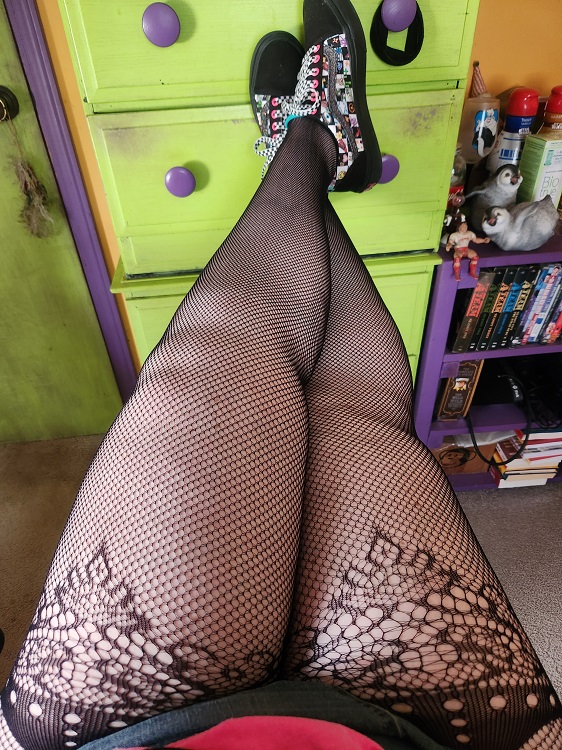 Likewise, when I’ve been taking pictures of my tights and/or fishnets, I do so with my legs propped up on my dresser. I do this because it’s a better lighting angle and you get a better view of my tights and/or fishnets. However, in doing this, it makes my legs look thinner than they actually are. It’s just the result of gravity pulling on my leg fat in a pleasing way rather than yanking on the bulk the way it does when I’m standing, or my thighs just squishing out to the county lines when I sit down.
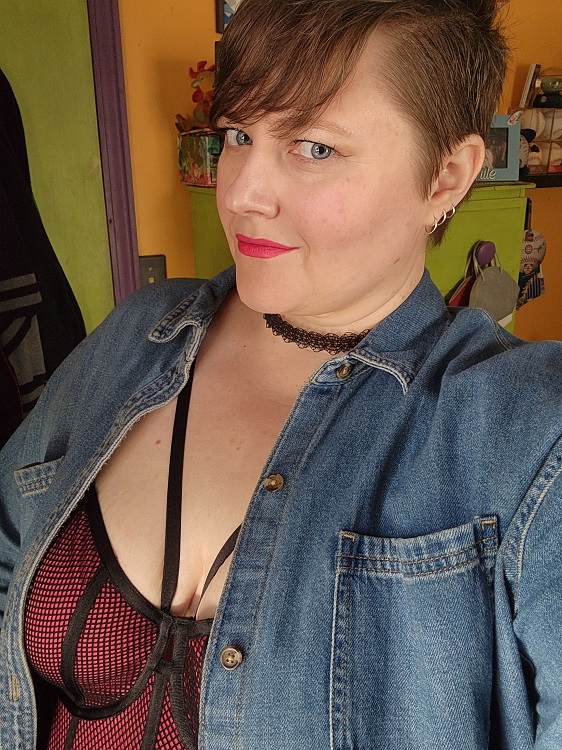 What I need is a full-length mirror (and a place to put said mirror). Then I could show off all of my cute tights and fishnets and outfits and my fat as well. Because I don’t like the feeling I sometimes get that I’m hiding how fat I really am. No one has ever said anything to insinuate that I was trying to work any deception, but when I get comments (especially from het dudes) about how good I look, I feel like they’re not taking into account that -as I’ve repeatedly stated and sometimes provided photographic evidence of- there’s a whole lot more of me to look at that isn’t in the picture they’re looking at. See how many compliments they give me when the can see the totality of me.
 Yes, I know. National Poetry Month is over and you’ve had all of my terrible poetry you can handle. That’s fair. But this isn’t about my poetry, nor will I subject you to any more of it (at least not until next April). This is about poetry in general and how I think that for the general public, it doesn’t get a fair evaluation.
 Kiki Writes About...