Poem–Magnificent Seven–“Chisholm”

I had the most terrible idea while I was struggling to come up with a blog post for the week. Yes, I could have just skipped -I doubt anyone would notice- but this idea came to me and I couldn’t pass it up.

I realized that there are seven months until National Poetry Month in April. And I wrote a poem about each member of the Magnificent Seven (2016) as an exercise to experiment with more poetry forms.

Do you see where I’m going here?

Yes! I will be subjecting you to my bad poetry outside of the confines of the month of April. I will be posting my Magnificent Seven poems on a monthly basis as a way to lead into National Poetry Month. Aren’t you excited?

I’m sure you’re ecstatic.

To make it worse, I’m going to go identify and explain the poetic form I chose for each poem.

No doubt you’re tingling with anticipation by now, so let’s get to it.

The first poem I’m posting is actually the last one I wrote for the Seven. I decided on a sonnet for Chisholm. You might remember that from English class when you were studying Shakespeare. 14 lines, usually rhymes, often has iambic pentameter. I managed the 14 lines and the traditional ababcdcdefefgg rhyme scheme, but aside from getting 10 syllables a line, really didn’t go hard for the iambic pentameter.

Close enough for bad poetry.

I also totally admit to incorporating a line from the movie into the poem. It was too good not to.

Chisholm

A man in black riding alone, trouble
he finds for his wage. Come the day
an offer is made and from precious rubble
emerges an old monster to be slain.
The promise of gold no match for his past,
he rounds up others who cannot resist
the lure of this flame, this fight to the last.
A challenge. Now his reason to exist.
Plans well laid, graves well dug, vengeance well sought
to save a home not his for one he lost.
Blood that’s spilled added to battles he’s fought,
the price he’s paid multiplies in its cost.
What the fires consumed, lost in flashes,
he finds it again sifting through ashes.

Read This If–You Wanna Revisit My Childhood

Back to school time always makes me think of my school days, back when my biggest concern was my mom buying the right flavor Kool-Aid and getting all of my homework done so I could play outside. During the summers, my mom would walk her daycare kids (and her two kids) up to the library to get books for the week. Back then, my mom was a big reader and she tried to pass that on to all of us kids. As a result, I remember working my way through The Bobbsey Twins and The Boxcar Children series. Unsupervised children solving mysteries was my jam. I also read a lot of Goosebumps and R.L. Stein books, too.

But I had some other books that I loved, too. I bet you might have loved these, too.

Scary Stories to Tell in the Dark by Alvin Scwartz- Folklore stories collected and retold by Alvin Scwartz and illustrated by Stephen Gammell in a way that scarred an entire generation, the book found resurgence when a film version was made in 2019. But for some of us, this book never went away. It was often an ’80s/’90s kid’s first introduction to literary horror and our first exposure to urban legends.
I remember reading this book with my hand covering up the illustrations because some of them were so intense, I couldn’t concentrate on the story. Not that the stories weren’t intense on their own. I’m sure more than one of those stories and/or illustrations were responsible for some nightmares.

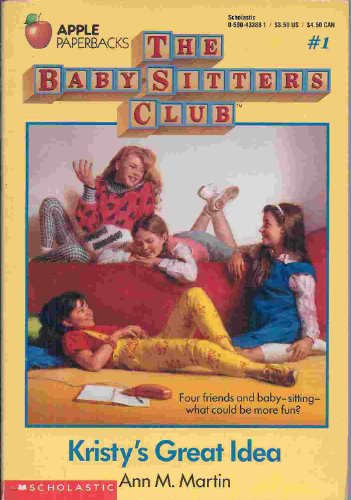
The Baby-Sitters Club by Ann M. Martin- This series of books about a group of teenage babysitters dealing with the challenges of child-minding and growing up was adapted twice as a television show, once as a movie, and is now available as a graphic novel, which I think is pretty cool. The series covers everything from dating to divorce to blended families to death to diabetes to learning disabilities to racism. There were also Super Specials and a Mystery series, as well.

It should come as no surprise that I came by affinity for the series out of ego because the president of the Baby-Sitters Club was named Kristin, went by Kristy (I went by Christi in grade school), and was a bossy tomboy like me. I didn’t read the entire series. At some point I lost interest, but for several years, these books had me by the collar. I loved them and couldn’t get enough of them.

The Midnight Club by Christopher Pike- A group of terminally ill teens living in a hospice get together at midnight to tell each other stories. According to author Christopher Pike, the book was the result of a request from a terminally ill teen who wrote to Pike and asked him to write about her and the other kids in her group who would meet at midnight to discuss his books. It was adapted as a TV series in 2022.
I read this book when I was a freshman in high school during study hall and I loved it. For years, I would randomly think about the book, but I couldn’t remember the title or author. Once I started working at the library, I used the book finding skills I developed to track it down…and then request it from another library. The reread was just the nostalgia I needed and the book held up to my faded memories.

I hope this little stroll down my memory lane inspires you take your own stroll. And if not, well, feel free to sit it out.

It’s Not Easy Socializing with a Brain Like Mine

Lately, I’ve been flirting with the idea of being more social. It’s a challenge for my introverted self. It takes energy that I don’t always have or want to expend. I’ve neglected that part of my life for too long and I don’t want to do that anymore. I want to leave my house more. It doesn’t have to be anything much. Once a month, go out with a friend, maybe for lunch or dinner or something. Socialize with someone outside of my house and the library. I need to make more of an effort to connect with the friends I have in my meatspace and this would be an easy, low pressure way to do that.

Right?

Well, my brain hasn’t met a good idea that it couldn’t turn bad. Or at least make seem impossible. Anxiety is fun like that.

The friends that currently occupy my immediate physical reality took a different path in life than I did. They got married, had kids, have full-time jobs in which they’ve been employed for years. You know. They all became functioning adults. Meanwhile, I’m over here avoiding adulthood like I’m dodging bullets in the Matrix. My point is that their lives are already very full. They’ve got a lot going on. Better things to do, as it were. My brain gleefully informs me that I do not need to be bothering these friends. They put effort into their lives. They’ve got their social circles. There’s no room for you anymore.

I do have some friends that didn’t entirely go the full-tilt adult route, didn’t get married and/or have kids. They would theoretically have more available time in their life to spend an hour eating food, drinking drinks, and talking about things and stuff with me. However, I still can’t find a way to justify that I’m not bothering them by asking them to hang out with me for a short while. I can’t imagine it being anything other than an inconvenience to them for me to ask, especially if they have to make an excuse because they don’t want to go.

My brain enjoys telling me that everybody hates me and I should go eat worms.

My brain also enjoys projection. My first reaction to someone asking me to socialize is usually a reflexive “no”. It’s too much work to get in the right brain space, I’ll be too anxious. Even if my immediate reaction is a “yes” or a “maybe”, I more than likely won’t feel the same way when the time comes to leave the house. Most often, if I commit to an outing, I will follow through because I know I’ll be fine (or close enough to fine) when I get there. It takes an incredible amount of mental gymnastics sometimes just to convince myself to go out. Why wouldn’t other people go through the same thing when I ask them?

Well, maybe because they have normal, more reasonable brains.

I’m not giving up on this idea that I can have a small social life. After all, I used to have one. It’s just a matter of ignoring the worst of my brain and sending that first text message.

It’ll be fine when I get there.

I’m Reacquainting Myself with the Sun

Since it’s almost the end of meteorological summer, I think I should talk about something I started doing at the beginning of it.

I’ve never had the best relationship with the sun. Probably because I’m pale and that fiery orb finds it offensive.

My parents and my sister all tan. My mother was a professional tanner in our youth, laying out in the backyard, listening to Cubs games on the radio in the summer and keeping regular tanning bed appointments in the other seasons. My father sported a lop-sided farmer’s tan from driving around on patrol for twelve hours a day with his left arm hanging out the window, the skin that arm getting darker than on the right, dark enough to make my mother jealous. My sister is the kind of person who might get a sunburn and it might last for a day or two, but it would eventually fade into a tan. And once she tanned, well, the chances of her getting another sunburn that summer plummeted.

Me? I go from white to red to white with no other stops on the color wheel. And I didn’t just sunburn as a kid. I burnt. It took no time for me to go from a little pink to deep red to blistered. Growing up, my mom would apply the sunscreen, but it was in the reapplications (infrequent and ill-timed) that I would end up toast. My sunscreen skills didn’t really improve as I got older either. It was a hassle. So, instead of exposing myself to the sun, I gradually retreated from it.

The results were predictable. Sure, I haven’t had a sunburn in years, but I’ve also achieved a paleness not even seen on a sickly Victorian child, which at one point was exacerbated by a bout of anemia. It’s not a pristine, delicate paleness, either. I didn’t get out of those childhood sunburns without a few battle scars. A whole lot of them actually. I’m covered in freckles. It’s the only melanin I have.

Over the years, I’ve attempted to get more sun. However, those attempts were often thwarted by my own laziness and hang-ups. I told myself that I couldn’t go outside on the days I worked because I had to work. I could go outside after work on Saturdays, but I’d sit in the very shaded backyard and not get much sun exposure. I could lay out all day on Friday or Sunday if I wanted to, but it seemed like I could never get out of the house early enough to catch the good sun. It was halfhearted and hopeless.

Then, this past spring, I revamped my morning routine and suddenly everything became possible.

I had noticed that when I took my laptop out in the backyard to write on occasional Saturdays after work or sometimes on my Fridays off, I seemed to be more productive. Why couldn’t I do that every day? I have a perfectly good patio table on a perfectly serviceable patio. I could sit at the table in the mornings, drink my coffee, write, AND get the sun I felt myself craving. Could it be that easy?

Friends, it has been that easy.

Not only do I write more and write it easier when I’m outside soaking up the sun, but I’ve also been getting on better terms with that harsh god. Our relationship has definitely improved with reasonable boundaries. I’m liberal with the sunscreen before going outside, I’m only sitting out there for about 30-45 minutes, and I’m not out there every day. I’m either actively taking a break from the sun or it’s too hot for me to realistically sit outside in direct sunlight in a black chair at a black table. I can only tolerate so much direct exposure and boob sweat.

Spending time outside this summer -as structured yet irregular as it has been thanks to heat waves- has boosted my mood, my creativity, and I’m a healthy shade of pale. In fact, I’m enjoying my mornings of sun, coffee, and writing so much that I don’t plan to give them up so easily come autumn. Or winter, for that matter. I live in the Midwest. Random warm winter days won’t go wasted.

After all, if I’m going to keep this relationship between me and the sun healthy, I’m going to have to work at it.

Honorably Mentioned

I’ve entered the Writer’s Digest Annual Writing Contest off and on for years. It’s a multi-category competition and I’ve tried my luck in many of them. My luck has been mostly bad. But I did earn 10th place in the genre short story category one year, and then years later earned 5th place in the movie script category.

I’ve made no secret of chasing my high school poetry glory days by entering poems into contests -including this one- trying to do better than the 2nd place I earned my sophomore year. It’s only sort of a joke.

Well, I finally got a laugh.

This year I entered two poems into the contest, one in the non-rhyming category and one in the rhyming category. I am pleased to report that my poem “Cobwebs” got an honorable mention in the rhyming category. It’s not a big victory. I’m not getting any prize money and my poem isn’t getting published. I get a neat graphic denoting my honor (not pictured) and my name listed on the website. And I’m happy with that.

No, it’s not 2nd place or better, but it’s more official validation than I’ve gotten for a poem I wrote in more than 25 years. I’m not taking that lightly. This means something to me. It’s a little pat on the back that suggests that maybe I’m not nearly as bad at this as I say, that maybe there’s some merit in continuing to do this.

Not that I’d ever actually stop writing poetry. Or writing in general. It’s been years since I’ve had anything published and yet I continue to spew words from my brain. But there’s something sparkly about having someone who’s not a friend or relative, a total stranger in the business of writing, to read something you wrote and say, “You know what? This is pretty good.”

I needed that. I needed that tiny victory, that little bit of external validation. It gives my ego a warm fuzzy that I didn’t realize that I needed. I’m grateful.

I’m also sad. I’m sad for my other poem that didn’t get honorably mentioned. I wanted it to be recognized, too. Clearly non-rhyming poetry is still a victory that escapes me. Even though it is the poetry I default to the most, that I feel most comfortable writing, it’s also the validation that I’m still chasing. I’m not sure what it is about that poetry that I’m missing, the thing that makes it worthy of the little pat on the back that I crave. Non-rhyming poetry is much harder than it looks.

Anyway, I think my non-mentioned poem is a neat little thing and I feel that it deserves its own little moment in the sun. I hope to give it that one day.

I hope that for both poems. Even though “Cobwebs” got that little bit of recognition, it still remains unread by everyone else. I was asked if I was going to make it available to read, and I’m still not sure. I’ve never submitted poetry anywhere except for contests. I’d like to try to get a poem traditionally published and maybe “Cobwebs” would be a good one to submit. It’s something to consider.

But for now, I’m just going to enjoy this honor for a little bit longer.

I Got a Bright Idea

I’ve been pondering the notion of self-publishing chapbooks or collections of my poetry. It would be easy to do since I already have plenty of experience self-publishing novels and novellas and short story collections. I know how to put a book together and I’ve made plenty of my own covers. I could do a print and an ebook version. No problem. Yeah, I’d have to do some research on the the difference between a poetry chapbook and a poetry collection and which would be the one to do. And, yeah, my poetry isn’t great and not really worthy of either of those incarnations. But that doesn’t matter. It’s a bright idea.

That’s the thing about me. I get a lot of bright ideas. Ideas that would probably be brilliant if they were executed by others. Ideas that fall significantly short of expectations because they are executed by me. It turns out that I am the lethal injection of bright ideas.

The problem with me and my bright ideas is two-fold: Once I get an idea I want it done yesterday; and I do not have what it takes to make my bright idea successful.

See, I have a very Field of Dreams attitude towards my bright ideas. If I build it, they will come. Only they don’t. Because I didn’t build it so great. And I don’t really have that kind of draw anyway.

I’ll give you an example. Patreon.

I got the bright idea to make a Patreon. I thought I knew what I was doing, thought I knew how I was going to do it, and went ahead and did it. I was just sure that I was going to attract patrons in no time at all. With what? I don’t know. My charm, I guess. Must have forgot that I have less of that than I have talent. I digress. The first incarnation of my Patreon was a disaster because I really didn’t develop my idea much past the initial sparkle. The second version –The Murderville novellas- was better because I actually had a plan in place and was able to execute it. It took a lot more work than the first version. Imagine that.

The current version of my Patreon, with the four tiers and multiple projects, is probably the best version of my bright idea. And it only took me more years than I wish to count. However, it’s still not the Iowa cornfield ballpark I was hoping for because a) I don’t put out nearly enough free content to attract potential patrons and b) it’s MY content. If there’s one thing I’ve learned from my years of writing is that I do not write what people want to read. Sure, my self-promotion game also isn’t the greatest (I feel like I’m annoying people), but if what I was promoting was even slightly appealing, I think it would make up for it.

This isn’t to say that I don’t appreciate the people who have become patrons. Yes, I question their decision-making skills, but I’m also grateful that they choose to continue to invest in my work. Knowing I have this little, core audience keeps my ego inflated. I’m just saying that I have a way of dimming my bright ideas so they don’t quite shine like they should.

I’ve done it with self-publishing, traditional publishing, podcasting, self-employment, .you name it. My creative endeavor bright ideas suffer in my hands. I don’t plan and construct them correctly because I’m in a hurry to get to that gain -money, attention, applause, advancement, whatever. I want the result. And the result is too often disappointing.

So for now, my bright idea of self-publishing my poetry will remain just that. A bright idea.

Want To See My Poetic Forms?

Last month I decided to make a point of working on my poetry. Specifically, I wanted to experiment with as many new poetic forms as I could. As someone who defaults to free verse and who only remembers a scant few forms from school, I thought it would be a good idea to learn a few more. Lucky for me, I have this handy dandy list of 168 poetic forms from Writer’s Digest.

I actually started doing this a couple of months before. I adore The Magnificent Seven remake from 2016, so I challenged myself to write a poem for each of the seven and each poem had to be in a different poetic form. I gave myself a break by allowing one poem in my default free verse, but the rest had to be a different form. It took a few Sundays, but I got all seven poems written. And I had a lot of fun doing it. (If you’re curious, the forms I used were free verse, sonnet, echo verse, nonet, sijo, espinela, and deibide baise fri troin.)

I’ve experimented with a few more forms since, but I decided to make July my little poem laboratory of trying out poetic forms. Here’s what I’ve learned:

-I don’t like forms with too many rules. There are some Irish poetry forms that I didn’t even try because they have more rules than a strict parent.

-But I do like some rules. They push me to up my game and have given me better insight into what I need to do to write a decent poem.

-I’m hesitant when it comes to rhyming and syllables. I think it’s a free verse thing. I want to be specific with my word choice, but I don’t want to be limited.

-But I also like the challenge of rhyming and syllables. Once I get the groove of it, I have a good time.

-I like to match my subjects to forms. It was interesting to see how I couldn’t make a poem work in one form, but if I switched the form, it happened like magic.

-I’ve discovered several new poetic forms that I’ll be using from now on. I’m no longer a one form poet.

Make no mistake that I will probably continue to prefer free verse, though now with other poetic forms in my utility belt, it will be less of a default and more of an intentional choice. But I think by trying new forms and finding new forms that I like, it’s given me a boost of confidence in my poem making. Is my poetry still bad? Yes. Is it less bad than it was before? Also yes. The needle has moved just a bit towards not-god-awful, and that is also a confidence boost.

Even though I will occasionally submit my poems to contests in a spaghetti-wall effort to try to reclaim the glory I once obtained by winning second in state in a poetry contest when I was a sophomore in high school, my main pursuit in poetry is the joy of it. Sure, every poem I write inadvertently improves my prose writing by making me translate emotions into words and those words need to be chosen and arranged carefully to help convey that emotion, which I in turn utilize in my prose. It’s the joy I get that really keeps me writing poems, though. Even when I’m writing about really messy emotions or enraging realities, there is a joy in the act that I can’t find anywhere else.

And now it comes in a stornello.

Read This If–You’re Not Big on Mysteries

I’m not a real big fan of mysteries. Nothing against them, I just struggle to enjoy them. I think part of the problem is that I was cursed with the stupidest superpower in that I can call a twist in a book/movie/TV show without even trying. It’s not much of a thriller when the thrill is gone.

But that doesn’t stop me from occasionally reading them. As it turns out, I’ve discovered that I’m really not that into thrillers, but old school mysteries and sometimes cozies are pretty enjoyable. Yeah, I still call the twists most of the time, but there’s something else about those kinds of mysteries that engages me. Maybe they’ll engage you, too.

The Mysterious Affair at Styles by Agatha Christie- The first Hercule Poirot mystery. A rich older woman is done in by a dose of strychnine and she’s got a house full of suspects, most notably her younger husband and one of her stepsons from an earlier husband’s previous marriage. Poirot has no trouble figuring out this murder is a real family affair.

I got this as an ebook freebie and though I was familiar with Agatha Christie’s work, I never read any of it before this book. I thought this one was fun, as murders go. Poirot is a charming detective to ride along with. There are plenty of red herrings and a fun twist. Honestly, it’s a good time. Because I enjoyed this one so much, I ended up getting another freebie of hers, the first Tuppence and Tommy novel, The Secret Adversary, which I also really liked.

A Study in Scarlet by Sir Arthur Conan Doyle- The first Sherlock Holmes mystery. Split into two parts, the first part details Watson coming to live with Holmes and the two of them investigating first the murder of a man named Drebber and then the murder of his secretary, a man named Stangerson. Naturally, Holmes solves the murder, and the second part of the book is the murderer’s back story. There are Mormons. I wasn’t expecting that.

Prior to reading this, I’d only experienced Sherlock Holmes in movies, mostly Young Sherlock Holmes and the Robert Downey, Jr. version, but also Basil Rathebone in the starring role as well. This was another ebook freebie that I decided to try. I was surprised how much I really enjoyed it, which I shouldn’t have been since I like the movies, and yet! I thought the book was a lot of fun. Like I said, I didn’t anticipate Mormons. I ended up reading The Return of Sherlock Holmes and The Memoirs of Sherlock Holmes after I finished this one and still had a good time.

Having Wonderful Crime by Craig Rice- Number seven in the John J. Malone and Jake and Helen Justus series finds Jake and Helen on vacation in New York City when they befriend a drunk bridegroom whose wedding night ends up a horror show when his bride disappears and a beheaded woman is found in her bed. Jake and Helen then call on their friend, attorney John J. Malone, to come from Chicago to help them solve this baffling mystery.

Thanks to Covid, the library’s book sale one year ended up being mystery bags labeled by genre. My roommate got a mystery bag of mystery books and thought I might actually like this one. She was right. It’s a bit screwball and a lot of fun. It’s got that zippy banter you expect between married couples back in ’30s and ’40s. The mystery is also something of a ride. I haven’t read any of the others in this series, or by this author (a woman who wrote under several names), but they’re on my list.

The Sunset Years of Agatha Sharp by Leonie Swann- The aging residents of Sunset Hall, a house share owned by Agatha Sharp, are stunned to hear that their neighbor has been murdered and thrilled that the body the police are currently investigating isn’t the one in their shed. The logical thing for Agatha and her housemates to do is find out who killed their neighbor so they can pin housemate Lilith’s death on them. The investigation takes them all over the village of Duck End as they try to unravel the mystery because of course, nothing is as easy as it seems.

Did I figure out the twists early? Yes. Did it matter? No. The folks living in Sunset Hall are so damn fun and quirky -old folks who had interesting younger years- that they’d be worth the read no matter what. And they still managed to surprise me! Hettie the tortoise is the best character, obviously. She was the only truly reliable narrator. And I was totally prepared to dislike the grandson, but he grew on me, sort of like he did with Agatha. It’s a little darker than some of the cozies I’ve read, but I still thought it was entertaining as hell.

I hope these mysteries solve your problem of liking mysteries. If they don’t, well, go find a clue elsewhere.

Favorite Cover Songs

I’ve probably already done a post like this in the past, but like the 20 Tracks post I did, this one was also inspired by a thread on social media. It came across my Blue Sky timeline asking for your favorite cover song. Some people were putting a lot of stipulations on determining their choices, but not me. I looked at the prompt and said, “I can’t pick just one” and it became a blog post.

Because I have so many that I want to mention, I’m grouping them into categories of sorts. I’m also lazy and not linking them to anything. You’re grown. You know how to internet. Work that search engine, baby.

One of the qualifiers someone mentioned in their favorite cover song determination was that it should be more successful than the original. Allow me to introduce you to The Monkees. “(I’m Not You) Steppin’ Stone” was first done by Paul Revere and the Raiders, but became a huge hit for The Monkees (twenty years later, The Monkees covered another song by Paul Revere and the Raiders, “Kicks”, for their twentieth anniversary album). Another one of their hits, “Mary, Mary”, was written by Michael Nesmith and was recorded by the Paul Butterfield Blues Band before The Monkees became a thing. Run DMC put their own twist on the song years later.

Speaking of The Monkees, Run DMC isn’t the only one who’s covered their songs. Everyone knows Smashmouth’s version of “I’m a Believer” thanks to the movie Shrek, but my preferred version is by the indie band Echo Orbiter. Another indie band, Bikeride, did my favorite cover of another Monkees song, “(Look Out) Here Comes Tomorrow”. In case you’re curious, they’re both on a compilation album called Through the Looking Glass: Indie Pop Plays the Monkees.

Let’s keep talking about The Monkees for just a minute, specifically, Micky Dolenz. He’s done quite a few covers during his solo career (including an album entirely of Nez’s songs), but two of my favorites that he’s done are “Crying in the Rain”, with his sister Coco Dolenz, and “Good Morning, Good Morning”, which was originally done by The Beatles (a snippet of their version was used with permission in the final episode of The Monkees). I kind of like Micky’s version better than the original. Don’t tell Paul or Ringo.

Let’s move on to The Beatles, shall we? Two of my other favorite covers of their classic songs: Aimee Mann’s version of “Lucy in the Sky with Diamonds” and Oingo Boingo’s version of “I Am the Walrus”. Goo goo g’ joob.

Another one of my favorite Beatles covers is Eddie Vedder’s version of “You’ve Got to Hide Your Love Away”, but then Eddie Vedder might be one of my favorite cover artists. Back in the day, I bought a Pearl Jam CD single (oh wow, remember those?) featuring covers of “Last Kiss” and “Soldier of Love”. I bought it for the “A” side, but I ended up loving the “B” side more.

One cover song cliche is slowing down a song. The technique is usually found in movie trailers. However, it’s not necessarily a bad thing. Three of my favorite slow downs are “Toxic” by The Chapin Sisters, “Light My Fire” by Julie London, and “Do You Wanna Dance” by The Mamas and the Papas.

My lack of distaste for slow downs is probably because my favorite kind of cover song is the one that switches genres.

My all-time favorite cover song is “Super Freak” by Bruce Hornsby, Ricky Skaggs, and John Anderson, who took the Rick James classic and gave it a country/bluegrass twist. It shouldn’t work, but it does. The Gourds did a similar makeover with Snoop Dogg’s “Gin and Juice”, which I also love.

Instead of slowing down, how about going harder? I have a sincere fondness for the hard rock/metal versions of “Barbie Girl” by MxPx and “La Bamba” by either Rancid or Overbass. I’m not sure which one as I acquired this particular tune during the questionable downloading days when not everything was accurately labeled and even the internet isn’t sure who did it. Also, Alien Ant Farm’s cover of “Smooth Criminal” deserves a mention. They took an already bad ass song and made it more bad ass.

If I need to go punk, I’ll go for Me First and the Gimme Gimmes, especially “Science Fiction/Double Feature” and “Different Drum” (another Nez penned song, this one made famous by Linda Ronstadt and Stone Poneys).

And if I really want to go wild, then I’m all about the pop jazz versions of “Wonderwall” by The Mike Flower Pops and “Smells Like Teen Spirit” by Paul Anka. Yes, you read that right. That Paul Anka. And, yes, it shouldn’t work, but it does.

Think I’m wrong? Keep it to yourself. Think I’m missing some good covers? Let me know.

Ruminations on the Accusation of Superficial Stylistic Choices in Storytelling

At the library I work at we offer two book discussion groups: general fiction/non-fiction led by the director, and sci-fi/fantasy led by the circulation supervisor. The other day I overheard a conversation between the circulation supervisor (who is my direct supervisor, so therefore, I am his biggest pain in the ass) and a member of his book discussion group. I guess the book they’re currently reading shifts back and forth between timelines. My supervisor complained that he didn’t like this timeline shifting. He felt the story could have been told linearly. He said the author just did it for show.

This statement caused a record scratch in my brain.

To put it plainly, I was offended by the dismissive tone of his opinion. I wasn’t particularly fond of the other person’s follow-up that everyone is writing dual timelines now, like it’s a trend. And maybe it is. What do I know? I don’t typically read much fiction with this type of storytelling style.

What I do know is that writing multiple timelines and shifting between them is fucking difficult.

One of my WIPs, What Happened to the Man in the Cabin?, is written with multiple timelines that the story shifts between. Once I stopped biting my tongue, I looked inward and asked myself if part of the reason my hackles raised was because I perceived this as a slight on my own work. And while, yeah, maybe a little of my instant rage was a gut reaction to a glancing ego blow, I think more of it had to do with dismissive attitude toward the craft as a whole.

Full disclaimer: I am not speaking on behalf of every writer. I can’t do that. I can barely speak for myself. I don’t know how every writer acquires, cultivates, and translates their ideas to paper. Speaking for myself, though, I can tell you how I do it and one thing I will screech from the top of my lungs is I don’t do things for show.

What Happened to the Man in the Cabin? is written in multiple timelines that are shifted between because that’s the story. That’s how the story is coming out of my brain. That’s how the story wants to be told. Maybe other authors have a little more say in their structural decisions, but I’ve found that a story is what it is and if I try to change what it is, then it does not is.

Sure, I could pull apart my story and tell it in a linear fashion to suit my supervisor’s taste, and you know what? He probably wouldn’t finish it because he’d find it boring. It would be a very okay story in which a terrible thing happens in this town and that terrible thing greatly impacts the lives of these people thirty years later. The end.

Or I could tell the story the way it’s meant to be told, which creates a whole lot more tension and much more impact when revelations are made. Maybe I’m biased, but I think this version would be a lot more interesting to read. It’s definitely been more interesting to write.

Which is another thing. I have no idea how other people write multiple timelines, but in my case, I had a basic outline of what happened in the past and what was going on in the now (and the near now in one timeline), and I just started writing. I didn’t write each timeline separately. I shifted between them as I wrote. I let my story tell me when to switch the timelines. Is that the best approach for this? I have no idea. This is the first time I’ve done it and I haven’t finished yet.

I haven’t read the book my supervisor was complaining about (for the record it’s The Book Eaters by Sunyi Dean, which I had to go look up because I couldn’t remember what the pick was, which is really kind of bad because I’m the one that makes the fliers for the book discussions, but anyway), so I can’t say whether or not he’s right and that the book would have been better off written linearly. I have no idea whether or not the author chose this story structure “for show” (I bet not). But I’m willing to go out on a limb in my belief that the choices she made -whether anyone agrees with them or not- were in the best interest of the story.

After all, the story is the boss.