
 Last month I decided to make a point of working on my poetry. Specifically, I wanted to experiment with as many new poetic forms as I could. As someone who defaults to free verse and who only remembers a scant few forms from school, I thought it would be a good idea to learn a few more. Lucky for me, I have this handy dandy list of 168 poetic forms from Writer’s Digest.
I actually started doing this a couple of months before. I adore The Magnificent Seven remake from 2016, so I challenged myself to write a poem for each of the seven and each poem had to be in a different poetic form. I gave myself a break by allowing one poem in my default free verse, but the rest had to be a different form. It took a few Sundays, but I got all seven poems written. And I had a lot of fun doing it. (If you’re curious, the forms I used were free verse, sonnet, echo verse, nonet, sijo, espinela, and deibide baise fri troin.)
I’ve experimented with a few more forms since, but I decided to make July my little poem laboratory of trying out poetic forms. Here’s what I’ve learned:
-I don’t like forms with too many rules. There are some Irish poetry forms that I didn’t even try because they have more rules than a strict parent.
-But I do like some rules. They push me to up my game and have given me better insight into what I need to do to write a decent poem.
-I’m hesitant when it comes to rhyming and syllables. I think it’s a free verse thing. I want to be specific with my word choice, but I don’t want to be limited.
-But I also like the challenge of rhyming and syllables. Once I get the groove of it, I have a good time.
-I like to match my subjects to forms. It was interesting to see how I couldn’t make a poem work in one form, but if I switched the form, it happened like magic.
-I’ve discovered several new poetic forms that I’ll be using from now on. I’m no longer a one form poet.
Make no mistake that I will probably continue to prefer free verse, though now with other poetic forms in my utility belt, it will be less of a default and more of an intentional choice. But I think by trying new forms and finding new forms that I like, it’s given me a boost of confidence in my poem making. Is my poetry still bad? Yes. Is it less bad than it was before? Also yes. The needle has moved just a bit towards not-god-awful, and that is also a confidence boost.
Even though I will occasionally submit my poems to contests in a spaghetti-wall effort to try to reclaim the glory I once obtained by winning second in state in a poetry contest when I was a sophomore in high school, my main pursuit in poetry is the joy of it. Sure, every poem I write inadvertently improves my prose writing by making me translate emotions into words and those words need to be chosen and arranged carefully to help convey that emotion, which I in turn utilize in my prose. It’s the joy I get that really keeps me writing poems, though. Even when I’m writing about really messy emotions or enraging realities, there is a joy in the act that I can’t find anywhere else.
And now it comes in a stornello.
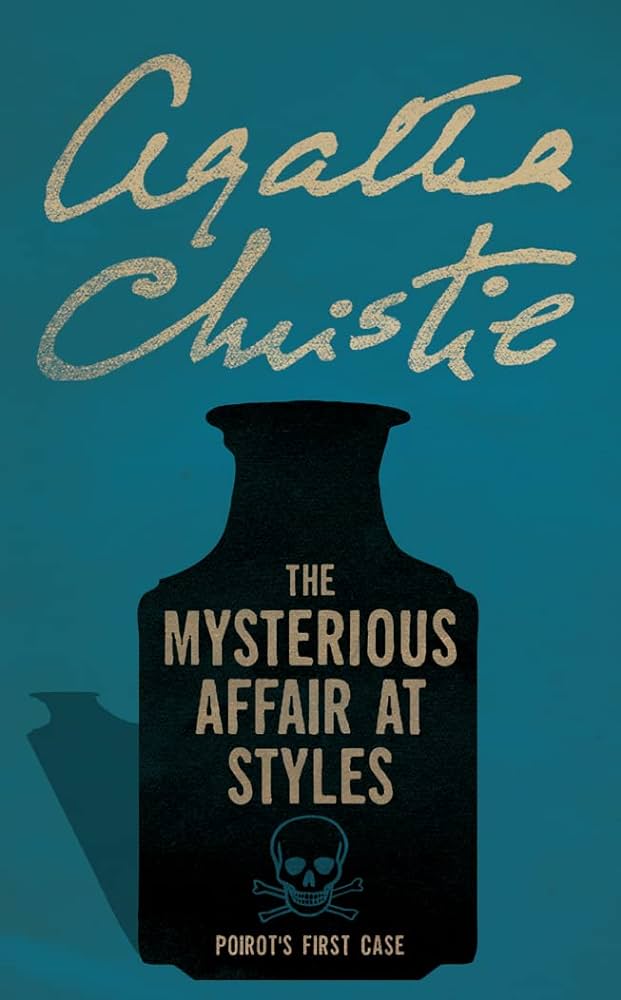 The Mysterious Affair at Styles by Agatha Christie- The first Hercule Poirot mystery. A rich older woman is done in by a dose of strychnine and she’s got a house full of suspects, most notably her younger husband and one of her stepsons from an earlier husband’s previous marriage. Poirot has no trouble figuring out this murder is a real family affair.
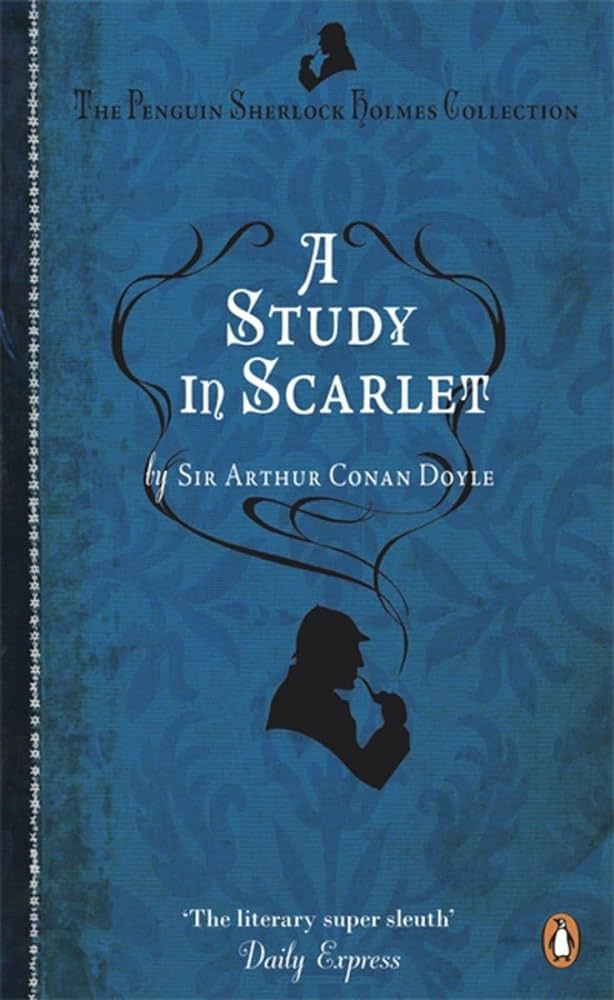 A Study in Scarlet by Sir Arthur Conan Doyle- The first Sherlock Holmes mystery. Split into two parts, the first part details Watson coming to live with Holmes and the two of them investigating first the murder of a man named Drebber and then the murder of his secretary, a man named Stangerson. Naturally, Holmes solves the murder, and the second part of the book is the murderer’s back story. There are Mormons. I wasn’t expecting that.
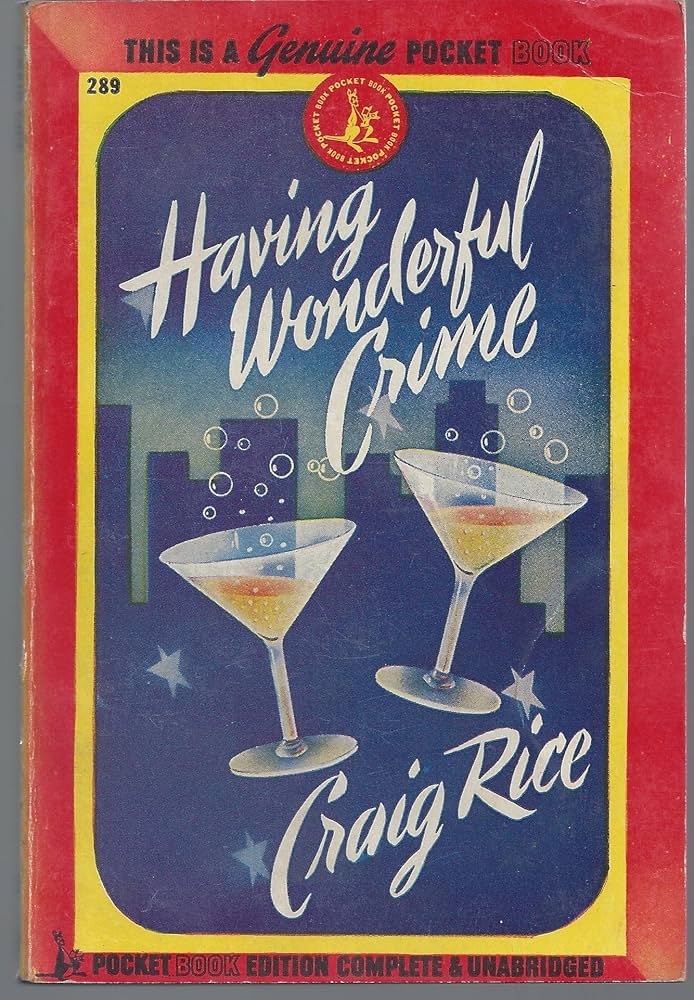 Having Wonderful Crime by Craig Rice- Number seven in the John J. Malone and Jake and Helen Justus series finds Jake and Helen on vacation in New York City when they befriend a drunk bridegroom whose wedding night ends up a horror show when his bride disappears and a beheaded woman is found in her bed. Jake and Helen then call on their friend, attorney John J. Malone, to come from Chicago to help them solve this baffling mystery.
 The Sunset Years of Agatha Sharp by Leonie Swann- The aging residents of Sunset Hall, a house share owned by Agatha Sharp, are stunned to hear that their neighbor has been murdered and thrilled that the body the police are currently investigating isn’t the one in their shed. The logical thing for Agatha and her housemates to do is find out who killed their neighbor so they can pin housemate Lilith’s death on them. The investigation takes them all over the village of Duck End as they try to unravel the mystery because of course, nothing is as easy as it seems.
 I’ve probably already done a post like this in the past, but like the
  At the library I work at we offer two book discussion groups: general fiction/non-fiction led by the director, and sci-fi/fantasy led by the circulation supervisor. The other day I overheard a conversation between the circulation supervisor (who is my direct supervisor, so therefore, I am his biggest pain in the ass) and a member of his book discussion group. I guess the book they’re currently reading shifts back and forth between timelines. My supervisor complained that he didn’t like this timeline shifting. He felt the story could have been told linearly. He said the author just did it for show.
 “I’m all for body positivity, but…”
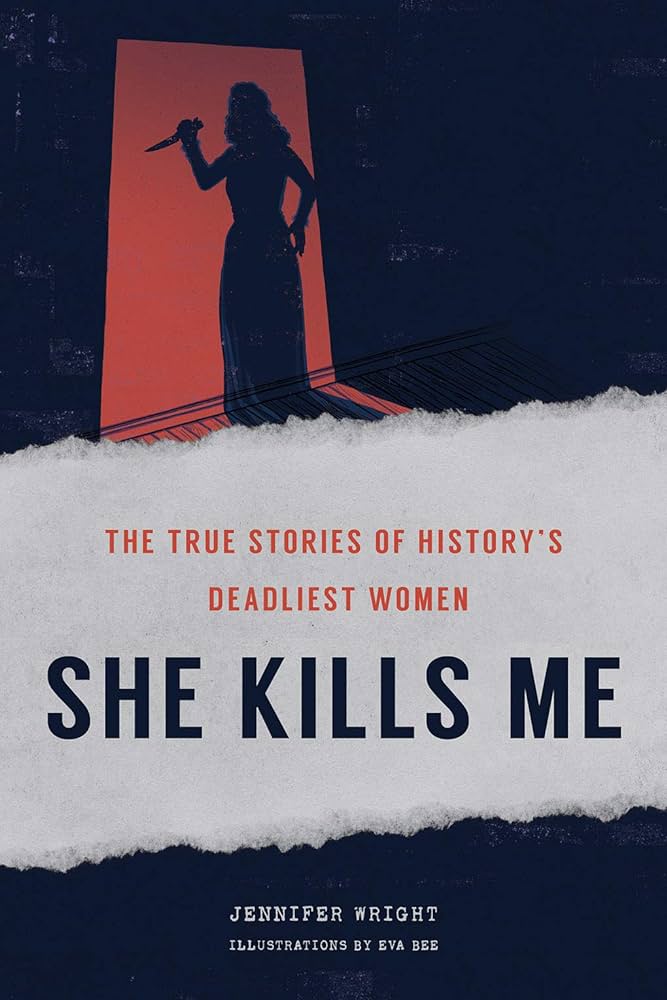 She Kills Me: The True Stories of History’s Deadliest Women by Jennifer Wright- Covering forty women, the book explains how they killed for a variety of reasons, including revenge, fear, necessity, and pleasure. Grouped by motives and/or means, there are poisoners, avenging angels, husband killers, family killers, mercenaries, women scorned, and women who would have made the grade on the ol’ psychopath test. Something for everyone, really.
 Unbecoming a Lady: The Forgotten Sluts and Shrews Who Shaped America by Therese O’Neill- It’s no secret that women tend to get left out of the history books. This book works to put 18 of them back in, so to speak. These are the women you wanted to learn about in history class because they were so ballsy that some of the milquetoast white guys you had to learn about would clutch their pearls in the presence of these women. In fact, some of them did because one of the women -Dr. Mary Edwards Walker- wore pants in public.
 I don’t remember what I was going to write when I first conceived of this blog post idea (I probably should have made some notes because, no self, you’re not going to remember it later), so let’s just write a bunch of queer thoughts, shall we?
 There are three kinds of people: morning people, night owls, and people who can do either. I happen to be a secret fourth kind of person who doesn’t like waking up period. It doesn’t matter when. Waking up pisses me off and I’m mad that I’m conscious.
 Second Chances in New Port Stephen by T.J. Alexander- Eli Ward is returning to his hometown of New Port Stephen, Florida, a very different person than when he left. Post-transition and sober, Eli finds himself moving in with his parents just in time for the Christmas holidays after the star of the TV show he was writing for decided to embroil himself in a scandal and put Eli out of work, something his parents don’t know. Running into his high school ex Nick Wu is the last thing Eli expects or wants, but the dedicated divorced dad with a busy life sparks a rekindling that could go beyond friends.
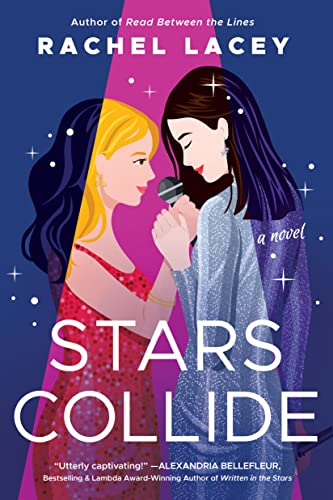 Stars Collide by Rachel Lacey- Eden Sands has been a pop star for twenty years, but after the break-up of her marriage, the flop of her last album, and a tour unsold out, she’s finding her star status dimming. She needs a boost, but balks at the possibility of doing a duet with up and coming pop star Anna Moss at the Grammy’s. Anna is desperate to be taken seriously and dueting with her idol Eden Sands could do that for her. When the two of them finally come together, it turns out that they’re better suited for each other than they thought.
 Kiki Writes About...