Writing–Taking Out

Last week I wrote about adding in to make a word count; this week I’m going to talk about taking out.

This is something I don’t have to do very often. Like I said before, I’m very bare bones. I usually fall below word count maximums.

Unless it’s flash fiction.

I typically don’t set out to write flash fiction, but my shorter short stories sometimes put me in that ballpark. And if I can find a place that suits the story, I’ll look to start cutting to make the word count.

Since flash fiction doesn’t offer much in the way of extra words and since my story is pretty short to begin with, I’m not usually cutting huge chunks of story; it’s typically just a couple of hundred words. Which doesn’t sound too difficult, but when what you’ve got is what you NEED to tell a story and you can’t lose much of anything or risk losing the integrity of the story, it’s pretty hard.

That’s when creativity and word choice become critical.

Granted, word choice is always important, but it’s a true test when cutting a story that really can’t afford much cutting. I have to say even more with one word because that’s all I’ve got.

This cutting also forces me to get creative with my sentence structure. No time for detours, I have to get right to the point. I have to state the idea as quickly and succinctly as possible without compromising grammar (too much), flow, style, readability, or enjoyment.

I’ve done this to a few stories, however so far the success is only measure by my actually getting it done to my own satisfaction. I’ve yet to get any flash fiction accepted for publication. Not for lack of trying, though.

And it’s nice to know that I have the cutting tools I need to make my stories better.

Stories By The Numbers

 -Submitted: 2
-Ready: 8
-Rejected: 1 (“Such a Pretty Face” once again finds no love)

The Reading of the Lips

Papa was hard of hearing. He had a good ear and a bad ear, and over the course of the years, the good ear got worse. We learned at a very young age to make sure we had Papa’s attention before we spoke and to speak loudly and slowly. Papa could hear some, but he also read lips to help fill in the blanks.

I grew up understanding the concept of reading lips, but as someone who could hear, didn’t really think much about it beyond knowing it helped Papa undstand us.

Then my mom turned me on to baseball and the Cubs.

The manager when I was a kid was Don Zimmer and he was a fiery, round man who liked to argue with the umpires. I remember him getting thrown out of several games. There’s nothing like a kid’s curiousity and I was dying to know what Don Zimmer said to get thrown out of the games. Since I couldn’t hear, I decided to do what Papa did and learn to read lips.

I taught myself by watching movies that I had memorized. I knew all the words, so I’d watch them without the sound on and watch how the actors spoke. From there it was just a matter of translating what I saw there to other people. It took some practice, but I got the hang of it.

The new skill served me well. I finally could figure out what Don Zimmer was saying when he argued with the umpires.

Turned out it was a long string of curse words, but the magic word seemed to be “mother fucker”. If you’re worried about my young girl’s mind being warped by being exposed to that word, please don’t. It wasn’t the first time I’d heard it…er…read it.

Since then I’ve applied it to more than just baseball. I’ve developed my own troubles hearing in certain situations and lip reading has bailed me out of some awkward situations.

I’ve also developed the odd habit of watching TV with the sound off. I’ve watched a lot of TV shows that way and for the most part I can keep up with the show. Obviously, I’m at a disadvantage if the speaker has their back to me or if there’s a lot of movement. However, I have gotten pretty good at filling in the blanks.

Or in the case of SyFy movies, making the movie even more interesting.

Now that I’ve gone full circle in a sense and am back to watching baseball regularly, I find myself once again being thankful for my skill. Sure it’s great for arguing managers, but my skills have improved since I was a kid. Now I use it to see what guys are talking about in the dugout and on the mound. I get a heads up at what pitch is coming next and I get to see what the guys on the bench and in the bullpen are discussing (hint: it’s not always baseball).

I’m still stumped by Spanish, though.

That’ll be the next level.

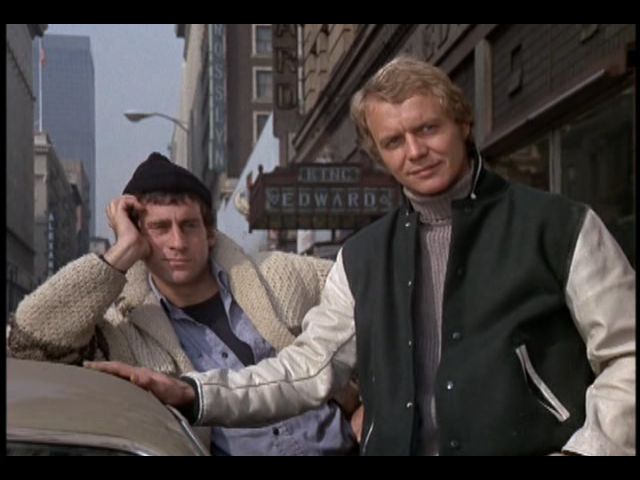
Rerun Junkie– Starsky and Hutch

The 70’s hit me hard when I was a young teenager. Never mind that it was the early 90’s at the time. I was in a love affair with a lot of 70’s reruns at the time.

One show that I rushed home after school to watch on TNT was Starsky and Hutch.

These two gentlemen had ladies swooning for four seasons.

-David Starsky (Paul Michael Glaser) and Ken “Hutch” Hutchinson (David Soul), plain clothes police detectives on the mean streets of LA with direction from their dedicated captain (Bernie Hamilton) and help from their snitch Huggy Bear (Antonio Fargas), not to mention a sweet Ford Torino.

Va-Room, baby.

The cases were gritty, involving drugs and murder, with a stock cast of 70’s bad guys (pimps, pushers, thugs, mobsters, cons, prostitutes). And of course, there were plenty of pretty girls to go around.

This is one of the earliest occurences of bromance on record. It takes buddy cop to the next level. The chemistry between the two is undeniable and they actually showed a pretty wide range of emotions for a couple of macho cops.

Two outstanding episodes that stick in my memory that highlight this are “Shootout” and “The Fix”. Both are early in the series (first season). In “The Fix”, Hutch is kidnapped and injected with heroin. Starksy working Hutch through detox really makes the episode. In “Shootout”, Starsky is shot during dinner at an Italian resteraunt and Hutch is charged with getting him (and everyone else) out alive. Agains it’s the death’s doorstep scenes that make it.

The show is awash in “Hey! I know that guy!” guest stars, but did score several recognizable names including Joan Collins, Suzanne Sommers, Lynda Carter, Mare Winningham, Jeffrey Tambor, Robert Loggia, Rene Auberjonois, GW Bailey, Sally Kirkland, Kim Cattrall, Veronica Hamel, and Pat Morita.

As per most 70’s cop shows, it could be heavy on the action and one or the other of the two main characters (sometimes both) found themselves in peril, injured, possibly dying, several times in a season.  It also stretched some credibility with some of the storylines and the revolving door of women in the guys’ lives were usually just good for an episode (though “Starsky’s Girl” was pretty poigniant). Huggy Bear, though, was good for the run and was often a fun bright spot to the episodes. Captain Doby brought some greatness as well.

This show is so a wash in 70’s goodness that it’s like good comfort food. It makes you wish that style was still alive.

Oh, yeah. That’s stylin’.

Well, almost.


Where I Watch It

Writing–Adding In

I was initially going to include “taking out” as well, since they seem to be two sides of the same coin with the same basic goals (meeting a word count and improving the story). But in the end I feel like they deserve separate posts.

And it guarantees that I have soemthing to write about next week.

I know the general rule is that it’s better to take out than put in. Most writers by nature seem to put a lot more into a story, particularly in a first draft, than what the story really needs and the extraneous material is later cut. I’m the opposite in the sense that my stories are usually pretty bare bones, particularly my short stories.

So when I come across an anthology or magazine that I thin kmight be a good fit for one of my stories and then I see that the minimum word count exceeds the word count of my story, I end up asking myself whether or not it’s worth it to try to expand the story to make the count.

Obviously, it ends up depending on the story.

A few stories I’ve considered expanding are definite no-go’s. Theyr’e done. There’s nothing more to add. Anything I put in is just going to drag the story down, water it down and weaken it. Definitely not what I want.

However, because I cut to the quick so much, I have found a couple of stories that can benefit from embellishment.

I added about 1,800 words of backstory to “Land of the Voting Dead” to meet the minimum word count for an anthology that looked to be a perfect fit. It was a bit of story that I had considered only in passing while creating the character of Miriam Showalter. I was pleased to discover that the addition worked; the added backstory gave the piece more depth.

And I guess I wasn’t the only one who liked it, since it got accepted for the anthology.

I”m currently in teh process of doing the same thing to “Spillway”. I need to add about 1,800 words in order to make the word count minimum for an anthology. There’s room in the story for some embellishment that I think will end up enhancing the piece. I think it will end up being better for it.

And if I’m lucky, the anthology editors will like it, too.

Stories By The Numbers

-Submitted: 3
-Ready: 7
-Accepted/Rejected: 0

The Name Game

In theory, parents take great care in selecting names for their children. The consider the meaning, possibly naming them after relatives, look at the initials, sound it out for the rhythm, spell it out for the look. They take into consideration the possible nicknames, good and bad, and seriously consider the consequences of the child living for the rest of their lives with that name.

In reality, they just pick something they like, spell it the way they want (something that’s gotten way out of hand), and then wonder why the kids end up hating their names.

To be clear, I don’t hate my name. I used to hate it when I was younger, as children tend to do when they’re growing up and establishing their identity, but now I can’t imagine being called anything else (nicknames excluded, of course). However, I have to admit that my mother saddled me with a pain in the ass.

It should be noted that this isn’t the worst name I could have gotten. She had several picked out for me, including Carrie, Lauren, Sara Elizabeth, and Christina Maria. Thanks to Dad for putting the kibosh on the last two.

It was late in her pregnancy when she added Christin to the possible name pool. She’d seen a movie called Hardcore starring George C. Scott. A lovely little film about a man finding out that his runaway daughter works in the sex trade. One of the characters was named Christin, though spelled Kristen in the credits, and Mom decided that she liked the name. We’ll just nevermind that the character was a porn star/prostitute and I would have to one day reveal that fact in my high school sophomore speech class.

(In contrast, my sister is named Lindsay after Lindsey Wagner. She got the Bionic Woman, I got a hooker. Years later I got my revenge by middle-naming two of my sisters kids after actors that portrayed a hobbit and a dwarf in The Lord of the Rings. Take that!)

I ended up with name Christin because my mother decided I didn’t look like a Lauren and Mom’s roommate in the hospital named her baby Carrie, which led mom to believe that I’d end up being one of many Carrie’s in my class. I always found that amusing considering Mom’s sister is named Kerri. Different spelling, same name, but that was apparently okay. And for the record, I didn’t have any Carrie’s in my class.

So I ended up with the name Christin.

My mother decided to spell the name the way it sounded, Chris-tin. And thus began my long, never-ending journey of constantly correcting people on the spelling and pronounciation.

The spelling I can forgive somewhat. I went to school with several variations of my name. Christin. Christan. Kristin. Kristen. Kristan. And that’s just the tip of the iceberg when it comes to how creative people can get. Out of boredom, I once came up with twenty-four different ways to spell my name. However, mine is one of the rarer versions. I could never find my own personalized stuff (I had to settle for Chris or Christi) and I could count on one hand the number of people I’ve seen with their name spelled like mine.

What really kills me is the pronounciation problem. I can also count on one hand the number of times I’ve had a teacher, college educated and literate, looked at my name and pronounced it correctly. Remember, my mom spelled it the way she thought it sounded. I’ve never had a kid read my name and mispronounce it. They’re learning to read and they learn that skill by sounding things out.

Adults, on the other hand, know how to read. They just glance at my name, get the gist of it, and I end up being called Christine, Christina, Christian, and in one instance, Kirsten. Going to school in a small town, I had a lot of the same kids in my classes for twelve years. By the time we were all seniors, a teacher mispronouncing my name would be met with a chorus of correction.

And that correction has continued, but I admit, I’m getting lazier and lazier about it. My name is misspelled on one of my bills. The IRS misspells my name on my tax refund checks (they really have no excuse as my name is spelled correctly on my social security card and they have that number). I had one driver at work calling me the wrong name for a month because I didn’t feel like correcting him on it. I waited until someone else did it, which was kind of a rotten thing to do, but when he asked me about it, I told him the truth.

“I’m used to people not getting my name right. I’ll answer to anything now.”

A lot of people don’t understand that. It’s my name. It’s a very important part of my identity.

True.

And thanks to a lifetime of people getting it wrong, that’s become part of my identity, too.

Writing–June Projects

May was terrible. I got nowhere fast and I feel like I’m just digging myself into a deeper hole that I won’t be able to get out of one day. My priorities are shot. I need a do over.

But enough writer’s doubt and whining. I’ve got June and if I can escape the computer problems that have plagued me the past two years, here is what I’d like to do:

-Keep revising The World (Saving) Series. I have got to gain some ground on it.

-Write/revise/post another Outskirts story.

That’s it. I’m pushing everything else off. Just those two things. I have got to find some focus and I’m taking this month to do it. I’ve either got to recommit myself or I’ve got to resign myself to the day job.

Choice needs to be made.

I’d better choose wisely.

Stories By The Numbers

-Submitted: 3 (Sent out “Customer Service”)
-Ready: 7
-Accepted/Rejected: 0

Writing–The Devil’s in the Details

I consider descriptions to be one of my biggest writing weaknesses. It’s not that I don’t like writing descriptions or that I struggle with it. It’s just that I don’t do it.

First drafts are all about getting the story down for me. The main focus is character, action, and dialogue. Sometimes I’ll throw in a detail or two in there if it comes to me or if I think it’s important, but for the most part, aside from setting and seeing, not much gets put in. Which is fine. It’s a first draft. It’s not supposed to be perfect.

The problem is that when I do revise the story, the details don’t always get added in.

That’s the part I struggle with.

Soemties I forget to add in the details because I know what it looks like, I know what’s going on, I know the scene, but I forget that people can’t see my mind. I have to translate it to the page. It’s pretty basic, but I still miss it every once in awhile. It takes someone else pointing out the vague description that makes me realize that my brain has been filling in the details for me, but I haven’t been putting them on the paper.

There is also, of course, my tunnel vision problem. I sometimes forget that I have other senses that can be used. Sight and sound are usually givens. Touch gets used some, too. Smell and taste are often forgotten. Sure, they’re not always appropriate to include in every story, but sometimes they mention of a smell or a taste can really enhance the setting or the scene.

The stories I’m most pleased with are the ones that I’ve used sensory detail well in. To date my favorite line comes from “Such a Pretty Face” about the “scent of stale onions hanging in the wet air”. It’s subtle, a throw away really, but it adds so much to the story and the scene. It’s my go-to line when I need to remind myself of the need to pay attention to detail.

The details make all the difference.

Stories By The Numbers

Submitted: 2
Ready: 8
Accepted/Rejected: 0

Bad Words: Selfish, Unaware, Unthinking

Selfish, unaware, unthinking.

Now we’re getting down to the nitty gritty.

I am a selfish person. I admit it straight up. My parents railed against any sort of selfishness from the time I was little. They told me to share, told me to think of others, put the needs of others before my own. It was never to be about me and always to be about someone else. Other people should be more important.

Well, I got news for you: those lessons didn’t stick.

That’s not to say that I don’t share or I that I don’t help people in need. I do my bits and pieces here and there and I’ve been told I’ve been a decent help to friends and family when they need it. I share what I have when I can when it’s appropriate.

But I am still the center of my own universe.

I admit it. I am as egocentric as they come. I’m selfish with my feelings and my attention and my interests. If it’s not about me, if it doesn’t pertain to me, if I am not involved in some way, you’d better believe there’s a good chance that I don’t care about it much. More than once I’ve done things or gone places or said words that I didn’t really want to do, go, or say just because I know it’s more socially acceptible to do so.

Many times, though, I don’t because I don’t want to. I put what I want ahead of what other people want.

I am most selfish with power. I will tell you right here and now that I may be a good leader, may handle responsibility well, but you do not want to give me any authority over other people. I turn into a tyrant. I don’t mean to, but it happens. I’m selfish, so it’s all about me. If it’s all about me, then it’s all about my way and my way is the only way. And because I don’t give myself a whole lot of slack when it comes to getting the job done, nobody else gets any either. Their performance reflects on me and I don’t want to look bad. All about me.

Since it’s all about me it leads me to be unaware of the thoughts, feelings, and needs of other people. I’m focused so much on myself that those things have a tendency to slip by me undetected (to be fair, I think  I earlier established that even if I am paying attention, I don’t always pick up on certain things). It’s not necessarily an intentional act of neglect; I’m not purposefully ignoring people. I’m just not paying particularly close attention to them because they are not me and what’s going on with them doesn’t pertain to me.

Because of all of this, I come off as unthinking. I already have the tact problem; the selfishness just compounds it. These two words combine with being unaware to make me appear so inconsiderate that the word doesn’t do it justice. I’m unthinking. I don’t bother to consider how my actions and words will affect other people. I’m that selfish.

Again, I’m not saying this out of pride. I’m saying it out of truth. I know I’m this way. I know I do these things. I’m not proud of them, but they exist. I’m not trying to excuse them, just acknowledge them.

The selfish things has given me a bit of a complex. Because it was drilled into me so hard as a kid not to be selfish, when I recognize my selfish behavior, it causes major guilt.

I don’t want to be selfish. I try not to be selfish. But I am and it still happens. As such, I don’t ever feel like I’ve earned any “me” time because I feel like I haven’t given enough time to other people, which has a tendency to make me more selfish because I haven’t gotten any “me” time. It’s a vicious cycle that I’m working very hard to break and not having a whole lot of success doing it.

And until I get my head out of my own ass, I’m not going to have much success at becoming more aware either.

The one thing I can say that I have improved is being a tyrant. I still have my moments, but I’m the first person to shun leadership and will only take it grudgingly. And then, I’m very, very careful about how I dictate and delegate.

The rest of my selfishness, just like the rest of me, continues to be a work in progress.

Writing–Writing for First Place

My first foray into the writing world was submitting my work to a local contest. The contest was cancelled due to a lack of interest and I got my story and entry fee back, but that was a pretty big step for me. It was the first time I let someone outside of a very specific group read something I’d written and judge me on it.

That contest didn’t pan out, but it gave me the courage to submit my work to others. My first real success as a writer was winning 10th place in the genre category in the 77th Annual Writer’s Digest Writing Competition. Imagine my surprise to open up my copy of the magazine and see my name listed among the top ten as I hadn’t been notified yet.

My story didn’t get published, but I saw my name in print. Someone thought my story was good enough to beat out at least 90 other people (the top 100 was listed on the site). It was an incredible ego boost and it encouraged me to move beyond contests and start submitting to publications.

Submitting to contests was a good first step for me. It let me ease into things. Not placing in a contest wasn’t the same as getting rejected in my head. Submitting a story and getting it rejected was more personal. My hide wasn’t thick enough to handle that yet. But losing a contest was different. I’d not won lots of things. That was easier to deal with.

Those first few contests and that first win really helped set the tone for me when it came to dealing with rejection. Let’s face it, submitting to a publication is a lot like entering a contest. You hope to win and get the prize, but lots of times you get that letter that lets you know that you’ve lost.

I’ve found so many ways now to deal with rejection that, while I get bummed and frustrated sometimes, I’ve never been devestated and rarely thought about giving up.

And I still have an appreciation for contests. Now that I’ve got that regular income from the day job, I can afford the fees once again. I once again entered the Writer’s Digest Story Competition. I’m hoping for a repeat of last time, if not a straight out win.

But if I lose, no big deal. I’ll just move on to the next contest and try this one again next year.

That’s what winners do.

Story By The Numbers

Submitted: 2 (“Another Deadly Weapon” is my contest entry; “Such a Pretty Face” is still out)
Ready: 9 (“Soul Sister” joins the growing list)
Accepted/Rejected: 0

Five Fun Times with Papa

To close out unofficial Papa Week here a Kiki Writes About, I’m focusing on some of the good times. Papa was the funnest grandpa a couple of girls could have. There was always a good time to be had when Papa was involved. Maybe they weren’t grand or expensive or even a big deal, but I wouldn’t trade them for anything.

1. Going to the fairs. We went to the county fair and the Decatur Celebration every year. Papa and Grandma would take us and let us ride whatever rides we wanted to and buying us funnel cake and lemon shake-ups. Sometimes Papa would ride some of the rides with us. There might be albums of pictures from out times at the fairs.

2. Playing computer. While most older people shun technology, Papa was ahead of the game as president of the Decatur Computer Club. He got us our first computer (a Commodore 64) and taught us how to use it. Whenever we’d visit his house, we’d all get together in the bedroom to play computer games. Lode Runner, Family Feud, Concentration, Motor Mania, and the Olympics were some of our favorites. He, my sister, and I would crowd around the desk and crack each other up while we played.

3. Cooking. When Papa retired and Grandma moved her dog grooming business into the garage shop at the house, Papa took over the cooking duties. He had shelves full of cookbooks and he’d always have the two of us help him no matter what he was making. Even something as simple as pudding, he’d have his girls help him. I licked a lot of beaters in my childhood.

4. Going to the store. Yes, even something that mundane was fun with Papa. First of all, it was a quaint little corner store down the road from the house. Second of all, a trip to the store before lunch meant that Papa would buy you a Hostess fruit pie that you could eat for dessert. And, of course, it gave Papa an opportunity to show off his granddaughters.

5. Any car ride. Papa had a big old green boat car he called Nelly. It had afghans for seat covers and a woven leather steering wheel cover, all made by Grandma. It didn’t have much of a radio, so Papa would sing while he drove. Old songs, usually Hank Williams. I thought it was kind of cheesy at the time, but now I can’t hear “Hey, Good Lookin'” without thinking of him.