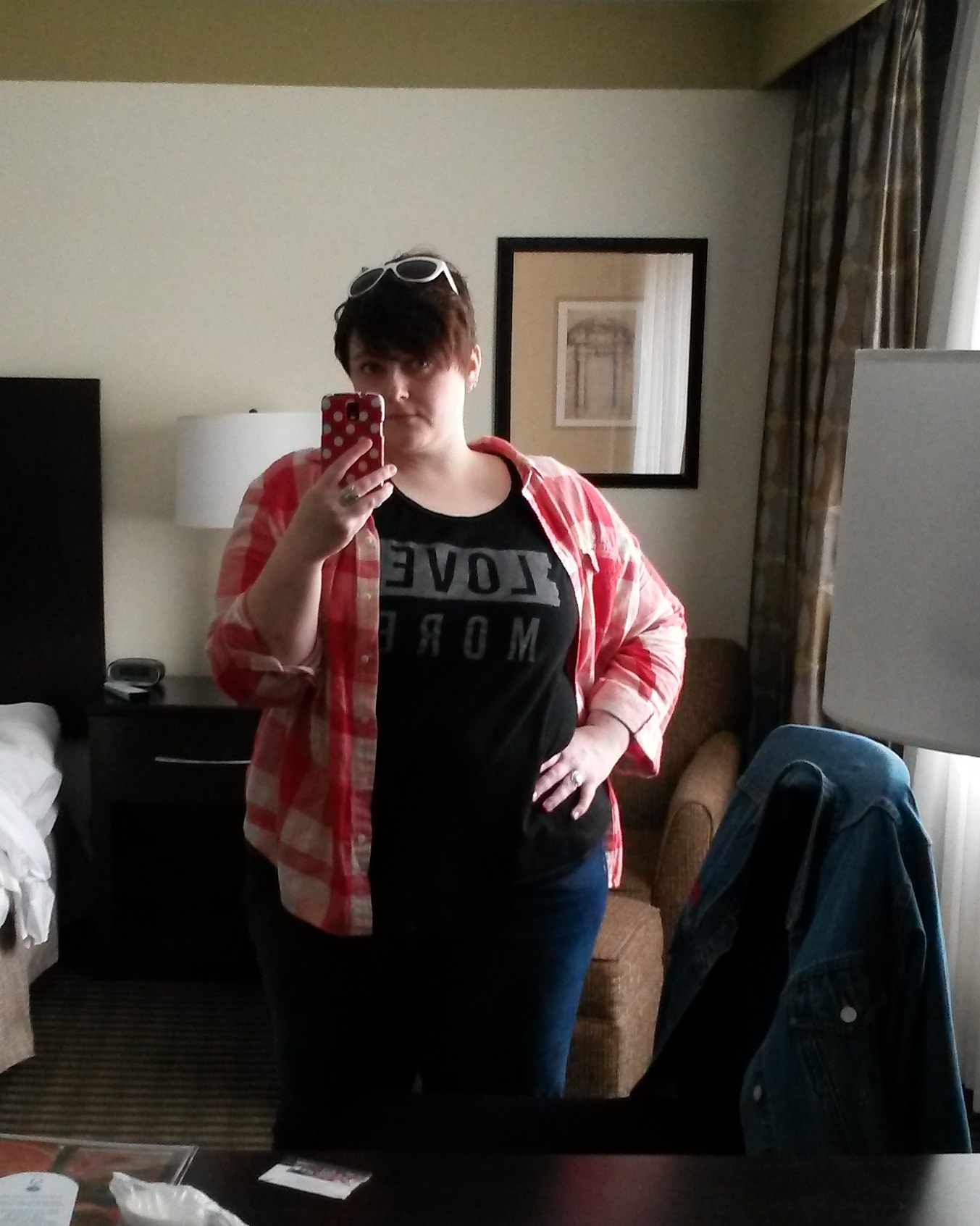
That Family Work Ethic

There are certain traits associated with the paternal side of my DNA. Stubborn. Funny. Resourceful. Fond of the drink. Great dancers.

Unbeatable work ethic.

It’s that work ethic that is legend. We don’t call in. We show up every day we’re scheduled, we do our job (and sometimes other people’s jobs), we do them well, and you can always count on us. While that is admirable to an extent, it has gotten me into trouble on occasion and caused an internal conflict I’ve only recently come to resolve.

I have my family’s work ethic. I show up every day I’m scheduled. In the past, I’ve gone to work sick and hurt. My record of not calling lasted for years and was only recently broken because my upper back went out. I couldn’t even stand up and there was no way I could put on a bra, but I was still looking for a way to go to work.

You would think that this sort of work ethic would make working forty hours a week no problem.

And yet!

I’ve worked full-time in multiple jobs and somehow in my younger years it was easier to bear. I guess because I was still riding high on the idea that it was what I was supposed to do. Make a living until I could find something better. And then make a living doing that. The goal, of course, was to be a responsible adult.

Which turns out to be something I’m not interested in.

I was unemployed when I began my third go-round at community college. I ended up going back to Walmart for the third time about a year later, but this time, I chose to work only part-time because of school. It was the first time I’d worked part-time since I was in high school and it turned out that I really liked it. I liked that I only worked four days a week and that I had fewer responsibilities than the full-timers. For the first time since I started working above the table, I wasn’t striving to get a promotion or be in charge or take on more responsibility. I went to work, did my job, and went home. And when I predictably dropped out of community college again, I kept my part-time schedule, this time because I had decided to get serious about my writing career and wanted that time to write.

The job I had after I got blackballed from Walmart was last full-time job I’ve had and I hated it. I hated the job and I hated being there 40 hours a week. I didn’t last a year.

At one point I held three part-time gigs at once and somehow I like it better than working 40 hours a week at one gig.

I’ve had the part-time library gig for over three years now. It’s hard to reconcile my famous family work ethic with my unwillingness to work full-time. Yes, I’m still serious about my writing career and have branched out to podcasting, and yes, I bust my ass at my library gig, showing up every day and putting in the effort, but my “real” job is still considered less real because it’s only part-time.

Can I still say I have my family’s work ethic?

Well, yeah. Because I realized that my work ethic happens to take after my Great-Uncle Junior’s.

Uncle Junior, like his brothers, was a working fool when he worked. He busted his ass when he worked. It’s just that he felt he should only work as much as he had to. “They can’t eat ya” is a family motto where bills are concerned and so long as his were paid, he was good. Sure, he lived in a bus by the river at one time, but that was because he wanted to, not necessarily because he had to.

As it turns out, I’m the same way. I only want to work as much as I have to and I have shaped my life to allow for that. Yeah, it’s not ideal and there are ways in which I’m hoping to improve it. I consider it my version of living in a bus down by the river. But until I can only work as much as I have to by writing alone, this is how I’m rolling.

Family work ethic intact.

Don’t Tell Me That–Creative Edition

As a writer one thing I want -aside from being paid to write- is for people to read what I write. When I publish something, or on the rare occasion when someone else publishes something I write, I naturally tell people about it because I’m excited. Something of mine is available to be read by your eyeballs! You should do that! I encourage it!

So, the last thing I want to hear when I tell you that something I’ve written is ready to be consumed is all of the reasons why you’re not going to read it.

Don’t tell me that.

I don’t need to hear how you won’t read my story because it’s not what you usually read or that you don’t like the genre or that you don’t have the time or that you don’t really read. I don’t need your excuses about why you’re not going to read my work. Just tell me “That’s great!” and we’ll all move on with our day. It saves a lot of awkwardness of me smiling and reassuring you that’s it’s all good while inside I’m dying of embarrassment.

I know why people do this. They’re worried that I’m going to later ask if they’ve read it. They’re worried I’m going to ask what they thought of it. They don’t want to get caught out later by having not done their homework. However, I’m not looking for a book report. There will be no quiz. This is not for a grade.

This is simply an announcement.

Like I said, as I a writer, what I want most is for people to read what I write. But I don’t expect it. I’m not going to insist that you read one of my stories just because we’re friends or family or acquaintances or I simply know of your existence. I would prefer that you read what I write because you want to, not because you think you have to. Nothing good comes of that.

Because that’s something else I don’t want you to tell me. How much you loved something I wrote when you didn’t actually like it. Or even want to read it. Yes, I do like to receive feedback on my stories, especially positive feedback. My ego loves to be fed. But I don’t need false praise. I’ve been rejected enough. My writer’s skin is pretty thick. It’s okay if you don’t like something I write.

Just don’t tell me that.

Even if you tell me that you’re going to read something I wrote, I’m not going to follow up with that. I’m not going to ask you if you got around to reading it or not, and I’m not going to ask you what you thought of it. In this case, I’m not going to hold you to your word about reading something you said you would. As far as I’m concerned, that’s up to you. And what you think about what I wrote is none of my business unless you choose to make it so. It’s not a requirement.

So, if you don’t like it, I’d rather you keep it to yourself. There’s no need to pretend that you did, nor tell me that you didn’t.

This is our get out of awkwardness free card.

I won’t ask, so you don’t have to tell me that.

It’s Only Love

The week of Valentine’s Day, when everything is draped in red, pink, and white, hearts and flowers and cupids plastered everywhere, romantic love is full on in the spotlight is the perfect time to point out that despite what society tells you, romantic love is not the pinnacle of the love hierarchy.

Actually, there is no love hierarchy. There are many different kinds of love and no one kind is better than another.

Society and the media would have you believe that romantic love is the end all when it comes to love, the tip top of the love pyramid. And it can be great, don’t get me wrong. I, myself, enjoy romantic love and would love to have more of it in my life. But I think it’s important to have all kinds of love in your life. No such thing as too much. As such, no one kind of love can be better than another. But most people have been conditioned to place romantic love on a pedestal anyway.

Familial love, platonic love, love for humanity…it all can have a place in people’s lives and it’s silly to think that one kind of love is somehow better than another. But even within those categories of love, we still try to create some kind of ranking system.

The love between a married couple is somehow greater than the love between an unmarried couple.

The love of a mother for her child is somehow the greatest love of all familial love, over any love a father can give to a child or siblings can have for each other. Grandparents, aunts, uncles, cousins…they all fall a very distant second. Hell, a mother’s love is even considered superior to romantic love. Sorry, spouse.

Platonic love is probably one of the lowest ranked love categories because the love of friends is nice, but not as important as a family member or spouse. Even then, though, we have best friends and just friends.

I think the societal insistence of these love perceptions aggravate and antagonize issues that people can have when it comes to their relationships. Why do you think so many people would choose a bad relationship over no relationship at all? The messaging is that there’s something terribly wrong about being single, that being alone is something to avoid at all costs. Even if it means settling for someone you only marginally tolerate and being somewhat baseline unhappy all the time. At least you’re not alone, right? Yeah.

Or what about his idea of a mother’s love? Now, I’m not knocking the love a mother has for a child, but let’s face the reality that not all mothers’ love is created equal. There’s this weird idea that you have to forgive your mother for everything simply because she’s your mom and that it’s the child’s responsibility to heal all of those wounds. Compound this with the substandard mother’s love that some children end up receiving, and it’s no wonder people develop relationship issues. If a mother’s love sets the standard and the standard set is toxic…well…there’s not much of a happy ending here.

Likewise, the people who hold the love of blood relatives over friends. The found family trope resonates with people for a reason. Those folks stuck with toxic blood find a blessing in the relationships with the friends they choose, only to be told that this is somehow less than the less than family they have. It festers a guilt about attachments. About loving your friends more than your family. About loving your chosen family over your blood one.

Obviously, people can and do overcome these issues, but think of how much easier it would be if they didn’t start with these inaccurate concepts of weighted love values. If we treated all love as being equal, then that’s one less issue to reconcile when working on our relationship wounds.

And maybe we’d get to place where we could enjoy our relationships more.

After all, it’s only love.

“That’s None of My Business”

Prince Harry released his memoir detailing his life and relationship with his family. The bits and pieces that leaked out were all the talk of my Twitter timeline and my anglophile roommate. Everybody had their opinions and assessments and evaluations and snarky comments and that’s terrific. But everything I’ve ever learned about the British Royal Family, particularly recently, has been against my will. I simply do not care about them or their family drama. Feel free to take your Jerry Springer shenanigans elsewhere because it is none of my business.

“Well, what about…”

There are plenty of people who care about this sort of thing. I do not need or wish to be one of them, thank you.

Keep calm and gossip on.

One bit of wisdom that has come to me with age is the gloriousness of minding my own business. I don’t have to care about everything. I don’t have to have an opinion about everything. Things that do not impact my existence directly are often best not considered. They do not concern me.

It’s none of my business.

Yes, I’m obviously not talking about important things. I wouldn’t mind my business if I saw someone being assaulted or thought one of my friends was being abused by their partner. But whether or not Prince Harry’s daddy loves him or if his wife is manipulating him for her own gain is none of my concern. That’s someone else’s responsibility.

That is none of my business.

I’ve taken to saying that to people when they try to talk to me about things that I don’t wish to engage with. And the response is interesting. It makes people stutter over their words because they’re not expecting that response. They’re not expecting someone not to engage with them, even politely, on the topic. They’re not expecting someone to say “That’s none of my business,” and then have to debate themselves on whether or not to defend themselves for making whatever it is their business.

For the record, that’s none of my business either. Whatever you choose to make your business is your concern, not mine. All I ask is that when I say it’s none of my business, you respect that.

I have found something very freeing in saying “That’s none of my business.” It’s like a dismissal of obligations. I don’t have to take on any weight associated with this. I don’t have to expend energy thinking about it or knowing about it. I don’t have to waste time talking about it or keeping up with it. It’s none of my business.

I realize that doesn’t sound like a lot. But think of all of the little things that are none of your business. Or my business. They add up. All that energy adds up. All those minutes add up. It’s time and energy better spent on something that actually is my business.

And I’ve got plenty of that.

“What Are You Working On?”

This is a trick question.

“What paranoia are you on about now?”

Hear me out. This is a trick question in two ways.

Number one, the person asking the question is more than likely just being polite. They don’t really care about what you’re working on. They’re just trying to pretend to have interest in your little writing hobby because they want to be supportive, but they’re really not that invested. You can tell by the way their eyes glass over and they nod along, not really listening, just waiting for you to finish so they can say, “Wow. That sounds great. I can’t wait to read it.” And we all know they’ll never read it. Because they’ve never read anything you’ve written because *insert reason here*.

The only correct answer to this question is to say what kind of project you’re working on.

“Oh, I’m in the middle of revising a short story for a contest.”

“Oh, that’s great. I can’t wait to read it. I hope you win!”

“Thanks.”

And scene. Small talk achieved. Everyone leaves with their egos intact. To go into any further detail about whatever you’re working on is to risk that glazed look and feeling your enthusiasm for your project/writing career deflate. And we don’t want that.

If they attempt to engage further by asking for story specifics, don’t panic in the face of this unanticipated interest. Simply demure, saying you try not to talk too much about your projects when you’re working on them.

Which brings me to the second tricky point.

If you do find someone who is genuinely interested in what you’re working on, then talking about the project, no matter how enthusiastic you are about it, can drain some of that energy you have for it. I don’t know why this is. But it seems like talking about the story you’re working on, particularly in the first draft stage, makes it less engaging to work on. It’s like the magic is escaping the bottle and it’s escaping because your dumbass keeps taking the lid off of it so other people can see it.

It’s true that sometimes talking about your work can help you see and/or fix problems with it, but if you’re not specifically looking for that feedback, then uncovering problems you didn’t realize you had when you’re enthusiastically telling someone about your great idea can be both jarring and demoralizing. Now you have to cover this realization because you don’t want the person you’re talking with to think that you have no idea what you’re doing. And god forbid if they’re the ones who point it out to you because you were oblivious to it. How embarrassing. Thanks for letting me know. I’ll fix that immediately.

And by fix it, I mean throw the story directly into the trash because I won’t be able to look at it without feeling the searing heat of shame.

You also run the risk of being told that your idea isn’t that great. Think about it. You’re absolutely jazzed about this idea and you’re thrilled with how it’s been going and someone finally asks you about it in a way that suggests they’re actually interested and not just being polite and you launch into your spiel and they just…don’t react. They smile. They nod. And then they say, “That’s nice.”

I’d rather be told my idea is shit than be told it’s nice. Nice is dismissive. At least disliking an idea is an actual feeling.

But you’re still left with that empty feeling of doubt, wondering if you’ve been wrong and this idea that you thought was a sure thing is really just another bust and maybe you should have realized that because it seemed so good and you never get good ideas that flow so well. Clearly, this was a trick of the writing devil, that prick.

And now you’re not feeling the idea so much anymore. Good thing it wasn’t really that good anyway.

Now do you see what I mean? A trick question.

So, never ask me what I’m working on.

I know you don’t care and I won’t tell you anyway.

Let Me Justify My Existence

I often say that I’m only happy when I’m stressed. Which is funny since an overabundance of stress kinda broke me once. But when it comes to my own projects and self-imposed deadlines, I am at my best when I am overscheduled. At least that’s what I tell myself.

The other day, though, I realized that it’s more than that. While I do like to keep reasonably busy with my projects and sometimes I do overschedule myself because in moments of productive optimism I forget myself, I think I also end up doing so many projects at once to justify my existence.

Allow me to elaborate.

I have -both by accident and by design- foregone a traditional adult life. I never wanted one and eventually finagled myself out of it. As such, I haven’t worked a full-time job since 2011 (I hated that gig). Even when I was working three jobs, I was still technically only working part-time. I have come to realize that I am very much like my Great-Uncle Junior: I am a working fiend when I work, but I don’t want to work anymore than I have to.

Which is fine. But that capitalistic narrative that’s been instilled in me since childhood that I was supposed to graduate high school, go to college, get a “good” job, get married, have kids, hit my mid-life crisis, get divorced, get re-married, and have my second family is still pretty ingrained despite all of my work at deprogramming myself. I feel compelled to prove that I’m not a waste of DNA and to justify my continued existence by throwing myself into my other work.

I worked full-time until I went to college the third time. I was between jobs when I started that last go ’round and when I finally got a new job, I only worked part-time because I was going to school. When I failed to go back because all I had left was math and science and I needed to bone up on my algebra before I took the placement test and I was going to take a semester off to prepare for that and I didn’t prepare for that and therefore, didn’t go back, I kept working part-time. I was returning to writing in earnest, I said. And I did. And when I inevitably walked out of that gig and got myself blacklisted from every being hired at Wal-Mart again (when I burn a bridge…), I was still committed to writing, even though I wasn’t really making any money off of it.

Fifteen years later, and I’m still playing that same song. Yes, I’m only working at the library part-time, but I’ve got multiple Patreon projects, podcasting projects, and writing projects going on, too. I’m not some lazy layabout. I’m working, I just don’t get paid for a lot of it. (Yet. One day.) It doesn’t help working with people who seem baffled that I could have anything else going on in my life considering I only work part-time and I’m not married and I don’t have kids. What do you mean you’re busy?

Believe me, I am very pressed.

The thing is that on a very conscious level, I know I don’t owe anyone an explanation for how I’ve constructed my life. It’s my business how I live and as long as I’m fine with it and it’s legal and (somewhat) moral, then you should be fine with that, too.

But on another level, I cannot escape the perceived judgment of society glaring at me like Sauron’s eye. It’s a guilt that I shouldn’t have, but that I still struggle to escape.

Maybe one day I’ll chuck it all into Mt. Doom.

Sorry, That’s Not My Problem–Customer Service Edition

The other day at work, my coworker recounted an interaction she’d just had with a patron while I was away from the desk (I was on shelving duty that day and she was covering my supervisor’s lunch). She printed out a receipt for the patron -it’s low-stick paper with the due date printed on it that we can slap on the item if a patron wants it- and it got caught in the printer. It’s been doing this all summer with both receipt printers for reasons (I think it’s another disapproval sign from the ghost of Ms. Kent). It’s annoying as hell, but it takes less than 30 seconds for us to open it up and retrieve the receipt.

This happened to my coworker while she was waiting on a patron, who said, “Never mind if it’s going to take long. I’m in a hurry.” My coworker had the receipt free by the time the woman had finished her sentence, but it still bothered my coworker that the woman felt the urge to get so snippy with her about it.

When my coworker told me about the incident, I shrugged and said, “You being in a hurry is not my problem.”

My coworker was shook that I would approach the situation like that. I told her, “Your emergency is not my emergency. Your time-constraints are not my time constraints. You come in here, you’re on my time now. It takes however long it takes.”

This made an impression on my coworker because the very next day she dealt with another patron whom she was trying to help find a specific movie in what’s known as WorldCat, which covers the whole country. It can be involved. And when my coworker wasn’t finding the desired results fast enough, the woman said, “I’m in a hurry.”

My coworker later told me that she turned away from the woman, mouthed to herself “That’s not my problem”, turned back, and said, “This can take a few minutes. Would you like to come back later when you have more time?” The woman declined, my coworker finished searching for the movie (nobody has it, which baffled us both), and the woman went on her way.

She wasn’t rude, the request was completed, and the point was made.

That’s not my problem.

The thing about customer service is that customers or patrons frequently want to make their problems your problems. And I do not accept anyone else’s problems. I have enough of my own that I’m in no mood to deal with. I’m definitely not in the mood to deal with yours.

Telling me that you’re in a hurry does not make me go faster. The task takes as long as it takes and it’s eyebrow raising at how many people will tell me they’re in a hurry like that will somehow make searching for a book magically go quicker. It doesn’t. I’m looking for a title that might be wrong by an author you don’t remember. Settle in. This is going to take a beat. If you’re in a rush, come back later. No one’s life depends on you finding this book right stat now.

Likewise, I’m sorry you waited until the last minute to send this fax, but it’s not my fault that they turned their fax machine off and it’s not my problem that whatever you’re sending is going to be late. Also, I don’t care if our dollar per page fee is too high. Pay it or learn to work email. Regardless, it’s none of my concern.

I’m not saying that people aren’t entitled to adequate customer service; of course they are. But I think that many people do not (or don’t want to) understand that the people behind the counter can only do so much. We’re only responsible for so much. If you want better customer service, then be a better customer.

And if that pisses you off, well…

That’s not my problem.

You God Does Not Apply to Me

One time a coworker of mine was going on about how the Devil was overtaking America and all I could think of was “Wow. That sounds like a Christian problem. Good luck with that.”

Rude? Maybe. But points to me for not saying it out loud. And even if I did say it out loud, at least I’d be speaking the truth.

It is a Christian problem.

Your God does not apply to me.

Your God believes abortion is murder? Wow. Sucks for you trying to access reproductive healthcare. But your God does not apply to me.

Your God believes being gay is a sin and marriage should only be between a man and a woman? Wow. That sounds pretty harsh. But your God does not apply to me.

Your God believes women should dress modestly? Okay then. But your God does not apply to me. Or my crop tops.

If you couldn’t tell, I’m not a religious person. Oh, I dabbled back in the day, mostly with Christianity, but it never stuck. I couldn’t jive with that God. Today, I believe in the Universe. It has everything. Some of the rules are kind of complicated, but only if you’re being graded on explaining them. It doesn’t judge you. It just is. I dig that.

In short, I do not believe in your God. And please do not counter with, “He believes in you!” He can do whatever He damn well pleases. It doesn’t change my position. Jesus might love me, but I opted out of his fan club.

As such, I do not have to abide by the fan club rules.

Your God does not apply to me.

I came across something the other day that summed up my feelings on this. Religion is a personal relationship with God. Personal relationship. What you do with your God is none of my business. It’s quite literally between you and your God. The trouble comes when you try to include me in your personal relationship. When you try to extend the rules of your personal relationship to include me. When you try to enforce the rules of your personal relationship at me.

Your God does not apply to me.

I’ll be blunt. I don’t give a shit what your God thinks. It’s none of my business and none of my concern. Because as it turns out, I do not need the threat of a displeased God sending me to a place of eternal suffering to make me act right. Judging by the behavior of some religious folks I’ve seen, they don’t take that threat too seriously anyway.

Insisting that your God applies to people your God does not apply to is not a demonstration of the strength of your faith. It is oppression. Using your God as a justification to harm and control others is not exercising your right to religion. It is denying that right to others.

If your God is a God who demands total obedience, who insists upon dominance, who propagates hate and bigotry and selfishness, who speaks loudly about helping but does no such thing, who doesn’t believe that prayer is a verb, then by all means, live in accordance to His law. Keep that shit in your houses and your churches and your prayer groups and your schools. Don’t try to make it law. Don’t subject the non-believers to that shit. That’s all your problem. Don’t you dare try to make it mine.

Your God does not apply to me.

I’m Not Patriotic By Nature

I know this seems a radical thing to say by someone raised in a country that prides itself on its patriotism, that injects the performance of it into so many aspects of life. I said the Pledge of Allegiance every morning in grade school like everyone else. I’ve sung the “Star Spangled Banner” before sports events. But they’re just motions to go through. They don’t stir that “America, Fuck Yeah!” feeling that I’m supposed to have, that unbridled, unconditional loyalty akin to what an avid sports fan feels for their team (now that I do have for my beloved shitshow Chicago Cubs). I do not well up with pride or any other emotion when I see the flag.

The patriotism didn’t take. Sorry. It’s just not my bag.

Now don’t get me wrong. I enjoy the 4th of July. I love a good theme. The color scheme and coordination, the insistence on consuming only barbecued meats and mayo-based salads, and there’s explosives. What more could a Midwestern girl want?

But I am not patriotic.

I do not feel an unconditional love to a bordered area just because of the happenstance that I was born there. Do I acknowledge that I was fortunate to be born into my circumstances in this country as opposed to perhaps another country? Yes. Do I also acknowledge that I could still have been less fortunate being born in this country, but into different circumstances? Yes.

None of the freedoms that I’m supposed to celebrate were given to me freely by this county I’m supposed to pledge allegiance to. All of them had to be fought for, bled for, and are now being casually ripped away. The only “freedom” I have going for me in this country is that I’m white. Everything else -being a woman, being queer, being poor, being non-Christian- disqualifies me. Why should I be patriotic to that?

Shouldn’t loyalty to country be no different than loyalty to anything else (except my loyalty to the Cubs)? Shouldn’t my country be as loyal to me as I am to it?

No. Because patriotism is an unrequited act. You’re expected to show your devotion, up to and including giving your life for you country, and in return you hope it spares you its worst. You point to the freedoms that are just illusions and claim that asking for anything more is an insult because this is the best country in the world.

I don’t feel that way. I don’t feel like there is a Best Country in the World contest and if there was, I don’t think America would be seeded as high as everyone else does. I personally don’t see a country that prioritizes the destruction of the people in other countries over the well being of the people within it’s own pretend outline as even making the Sweet Sixteen, let alone the championship game.

People conflate patriotism with gratitude. I can be grateful for my existence (or not) and how where I live influences my existence. I can be grateful that I live in the middle of a cornfield in a perceived blue state in a carved up United States. But that gratitude is not patriotism.

I am not a patriotic person.

I just live here.

That’s How the Story Goes

“And then what happened?”

I get that questions sometimes after people read some of my stories. The end satisfies the narrative, but not necessarily the reader’s curiosity. So, I’m going to answer that question once and for all.

I don’t know.

That’s where the story ends. I have no idea what happens beyond that for the most part.

Someone once asked me if the protagonists in one of my novellas hooked up after their ordeal and I told them no, but the only reason I had an answer to that question was because of the narrative itself. I had never intended on them becoming lovers at any point. Their relationship was purely platonic and surviving the night didn’t change that.

Those questions I can answer. But things like, “Did the leaves come back the next day?” “Did that shadow haunt the brother?” “Where did he go?” I don’t know. That’s where the story ends. I have no more story in my head after that.

This is all in the same vein as “This short story should be a novel” or “This should have a sequel”. While I appreciate the compliment that you love the story so much that you want more of it, I regret to inform you that there is no more. That’s the story in the form that it’s supposed to be. That’s it. That’s all of it. There is no more.

I don’t know what it’s like for other writers, but for me, the story is the story and that’s how the story goes. I’m not much of an overwriter. I don’t tend to have some huge, detailed backstory that I’m not putting in my fiction. I’m not one to do detailed outlines of my characters lives and their likes and dislikes. I don’t have a need to go much beyond whatever the context of the tale I’m telling is unless it pertains directly to the tale.

I start where the story starts and I end where the story ends and I don’t know much more about it than that. That’s all the story there is.

Of course, knowing this doesn’t stop me from wondering “and then what happened” about some of the novels and stories I read. I don’t ask the question out loud, obviously, because I know the answer (or what my answer would be), but I’m still compelled to wonder. And my imagination takes me in all kinds of directions and I come up with all sorts of answers for “and then what happened?”

I think that would be a better go-to answer for me. “I don’t know” is accurate, but invites negativity and accusations (“What do you mean you don’t know?” It’s a story, not an alibi for murder. Calm down). What I should do is answer that question with the question, “What do you think happens?”

Because most likely the person who asked that question, already has an answer in mind.